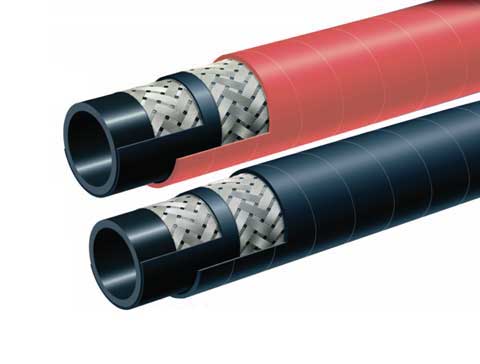
GB/T 24145-certified 34.5 MPa petroleum drilling and production hose with four-layer steel wire reinforcement
release date:2026-11-16 10:34:38
reading volume:
share:
In conventional onshore oilfield drilling and medium-to-high-pressure workover operations, a working pressure of 34.5 MPa represents the most common operating range. Standard high-pressure hydraulic hoses are ill-suited for these environments; they lack the necessary resistance to mud erosion and fail to meet the petroleum industry’s mandatory safety standards. Prolonged use often leads to rapid internal wear or sudden hose bursts, causing operational downtime and incurring significant safety and maintenance costs. Our 34.5 MPa oil-drilling hose—featuring a four-layer steel-wire-wound construction—is developed and manufactured in strict compliance with the national standard GB/T 24145 for rubber hoses used in rotary drilling and vibration dampening. Its robust, four-layer, high-strength steel-wire-wound design ensures stable, continuous, and safe operation at a rated working pressure of 34.5 MPa, providing a highly reliable, flexible piping solution for medium-to-high-pressure drilling and production operations in conventional oilfields.
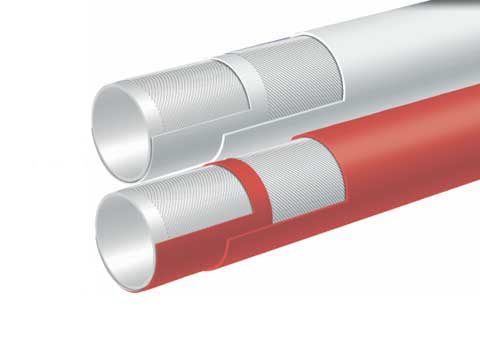
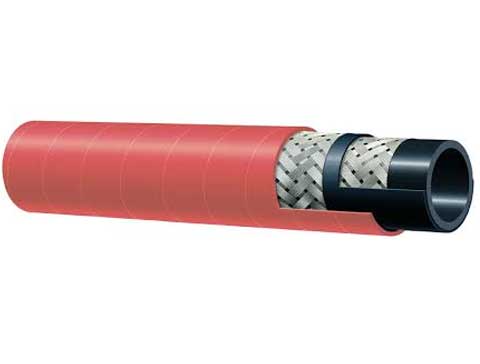
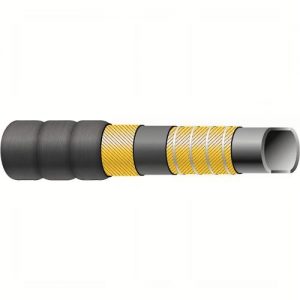 Optimized four-layer steel-wire-wound structure: stable pressure-bearing capacity with ample safety margins.
Most standard industrial high-pressure hydraulic hoses are designed for use with clean hydraulic oil and typically offer a pressure safety factor of only 3x. This falls well short of the mandatory requirement under the GB/T 24145 standard for oil-drilling hoses, which stipulates a burst safety factor of at least 4x. Deploying such hoses in oilfield drilling environments poses a severe risk of hose rupture. In contrast, this GB/T 24145-certified 34.5 MPa oil-drilling hose utilizes four layers of ultra-high-strength, high-toughness galvanized steel wire, arranged in an alternating pattern at an optimal winding angle of 54°44′. Through fluid dynamics simulation, the tension and placement angle of each wire layer have been precisely optimized to ensure uniform stress distribution across the entire hose wall, eliminating any localized weak points under pressure. The four layers of steel wire are composed exclusively of high-strength, specialized steel wire designed for oilfield applications, with each individual wire possessing a tensile strength of no less than 2000 MPa. During the winding process, the tension of each layer is precisely calibrated using high-precision, numerically controlled (CNC) equipment, ensuring that tension deviations are kept to an absolute minimum. This results in a uniform wall thickness throughout the entire hose, eliminating weak points caused by localized wire overlapping or uneven tension. The finished hose achieves a minimum burst pressure of 138 MPa—four times its rated working pressure of 34.5 MPa—fully satisfying the 4:1 burst safety factor mandated by the GB/T 24145 national standard. This provides a safety margin far exceeding that of standard industrial hydraulic hoses, enabling the hose to withstand the instantaneous pressure surges and "mud hammer" effects common in oilfield drilling and production operations, thereby preventing catastrophic hose ruptures.
Specialized, highly elastic rubber isolation layers are positioned between the four steel wire layers. These layers prevent direct contact and friction between adjacent wires—which could otherwise lead to internal wire wear or breakage under high-pressure pulses—while simultaneously enhancing the overall bond strength between the layers, preventing delamination during prolonged exposure to high-pressure, fluctuating conditions. The entire steel-wire-reinforced structure has successfully undergone over 150,000 cycles of 51.75 MPa pressure-pulse testing; the hose wall remained completely intact, with no signs of bulging or wire breakage, making it ideally suited for the continuous, high-pressure, pulsating demands of routine oilfield drilling and production. Furthermore, the four-layer steel wire structure offers exceptional tensile and pull-out resistance. The coupling assemblies at both ends of the hose exhibit a grip strength significantly higher than the minimum requirements set by the GB/T 24145 standard, ensuring that even under 34.5 MPa of high pressure, there is no risk of the hose separating from its couplings—a critical safety feature. A specialized material system for oil drilling and production: engineered for superior erosion resistance, corrosion resistance, and weatherability.
Standard industrial high-pressure hydraulic hoses are designed exclusively for clean hydraulic fluids; they are entirely unsuitable for the harsh conditions of oil drilling and production, where they face high-velocity erosion from sand-laden drilling mud, corrosion from various oilfield-associated media, and long-term degradation due to outdoor exposure. Such hoses typically fail rapidly as their inner liners wear through. In contrast, this 34.5 MPa oil drilling and production hose—certified under the GB/T 24145 standard—features a material composition optimized specifically for the complex demands of oilfield operations. It offers a comprehensive performance upgrade, delivering exceptional resistance to mud erosion, chemical corrosion, and environmental aging.
The inner liner, which comes into direct contact with high-pressure drilling mud, utilizes a formulation based on hydrogenated nitrile butadiene rubber (HNBR) to resist both oil and mud. For applications involving highly abrasive, sand-laden drilling fluids, an optional ultra-high-molecular-weight polyethylene (UPE) wear-resistant liner is available; this reduces wear by over 45% compared to standard nitrile rubber, significantly extending the service life of the liner against high-velocity, hard-rock debris—effectively solving the common issue where standard industrial hydraulic hoses are worn through after only a few hundred hours of mud transport. Furthermore, the inner liner is resistant to the long-term corrosive effects of water-based muds, oil-based muds, and media containing trace amounts of sulfur. It maintains stable physical properties across a broad temperature range—from -35°C to +120°C—without the rapid swelling or degradation often seen in conventional rubber when exposed to complex oilfield fluids.
The outer cover is constructed from a weather-resistant chloroprene rubber (CR) formulation, enhanced with specialized additives for wear, UV, and ozone resistance, as well as protection against oil contamination. This ensures that the hose remains durable even when subjected to the intense UV radiation and high levels of oil exposure typical of outdoor oilfield sites, preventing the rapid chalking or cracking of the outer layer and making it perfectly suited for continuous, long-term operation in onshore oilfield environments. The outer rubber layer has been reinforced and optimized for superior wear resistance. It can withstand frequent dragging and friction against the rough steel surfaces of drilling rigs or gravel-covered ground without wearing through prematurely. This layer serves as a robust protective barrier for the internal four-layer steel-wire reinforcement, preventing external corrosive agents from penetrating and damaging the high-strength steel wires within.
All rubber layers of the hose undergo a continuous high-temperature vulcanization process in a large horizontal vulcanizing autoclave, achieving molecular-level fusion and bonding. With an interlaminar bond strength of ≥2.2 kN/m, the hose remains stable even under long-term high-pressure pulsating conditions—eliminating risks such as gas migration between layers or delamination and blistering—thereby ensuring the structural integrity of the entire composite assembly. The hose’s bending performance has been specifically optimized, featuring a minimum bend radius of just 10 times its diameter. This allows for easy routing within the confined space of a drilling rig, enabling flexible connections without the need for forced, sharp bending. Furthermore, it effectively dampens high-frequency vibrations generated by the standpipe during drilling operations, preventing the cracking of welded joints often seen in rigid metal piping.
Fully compliant with the GB/T 24145 standard, this solution drives cost reduction and efficiency improvements across the entire lifecycle of oilfield drilling and production operations.
In China, high-pressure hoses used in oil and gas drilling and production are subject to mandatory national standards. Products that fail to meet the GB/T 24145 standard cannot pass the entry inspection requirements for oilfield sites. Should a hose rupture during operation, the resulting downtime and safety risks could lead to incalculable losses. This four-layer, steel-wire-wound, 34.5 MPa petroleum drilling and production hose is certified under the GB/T 24145 standard. From the inspection of incoming raw materials to the final testing of finished products, the entire manufacturing process strictly adheres to the national standard GB/T 24145-2009 for rubber hoses used in rotary drilling and vibration dampening. Each hose undergoes a pressure test at 51.75 MPa—1.5 times its rated working pressure—before leaving the factory. Every unit is supplied with comprehensive test records and material certification, fully meeting the entry acceptance requirements for standard domestic oilfields.
In conventional onshore oilfield drilling operations, where hoses are used for mud transport in drilling risers, standard industrial high-pressure hydraulic hoses often fail within a year due to the inner lining wearing through and causing a burst. Such failures lead to emergency interruptions in drilling, with downtime costs potentially reaching hundreds of thousands of yuan per day. By switching to this 34.5 MPa hose—which complies with the GB/T 24145 standard—the service life can be extended to over three years. This significantly reduces the frequency of hose replacements and eliminates the massive production losses caused by unplanned drilling downtime. For high-pressure circuits used in well workover and acidizing operations, the 34.5 MPa rated working pressure is perfectly suited to the requirements of standard oilfield workover tasks; it reliably withstands intense pressure fluctuations, ensuring safe and continuous progress for workover operations.
To accommodate the specific needs of various drilling and production environments, these hoses can be fitted with standard oilfield-grade union or flange connections. Upon delivery, they can be connected directly to the standard interfaces on drilling rigs without the need for complex, additional port machining—perfectly meeting the demand for rapid on-site installation. For winter operations in the frigid oilfields of northern regions, the hoses can be upgraded with low-temperature-resistant materials; they maintain excellent flexibility even in extreme cold as low as -45°C, preventing the embrittlement and cracking typically associated with low-temperature environments. During routine operations and maintenance—and in accordance with the periodic inspection requirements stipulated by the GB/T 24145 standard—users can assess the condition of a hose by checking its outer layer for visible signs of wear, bulging, cracking, or aging, and by conducting scheduled pressure testing. This approach allows for a rapid evaluation of the hose's integrity and fully complies with the safety and operational management protocols for domestic oilfields.
For operators engaged in standard onshore oil and gas drilling and workover activities, selecting this four-layer, steel-wire-wound, 34.5 MPa petroleum drilling and production hose—which meets the GB/T 24145 standard—offers significant advantages. It not only substantially reduces the annual procurement costs for medium-to-high-pressure mud transport lines but also eliminates the critical safety risks and massive losses from operational downtime that can result from the sudden bursting of non-compliant hoses. Consequently, it provides a highly reliable, flexible transmission solution for medium-to-high-pressure drilling and production operations in domestic oilfields, fully adhering to mandatory national standards.
Previous: