Server Liquid Cooling Hose: PTFE-Lined, Fluorinated Fluid Resistant – Designed for Immersion Cooling Systems
release date:2026-10-08 09:47:24
reading volume:
share:
 In immersion liquid cooling systems, server motherboards, chips, and cables are fully submerged in a fluorinated cooling fluid. Fluorinated fluids exhibit extremely high chemical permeability; consequently, standard rubber hoses in this environment swell and leach plasticizers within weeks. Dislodged particles can circulate with the coolant into chip microchannels, posing a direct threat to the safety of high-value computing equipment. PTFE-lined hoses designed for immersion cooling offer a specialized solution for this medium: their carbon-fluorine molecular structure ensures near-universal chemical inertness; an operating temperature range of -60°C to +260°C accommodates both single-phase and two-phase fluorinated fluid conditions; and their extremely low permeability prevents the leakage of expensive coolant. Thus, they serve as reliable conduits—resistant to fluorinated fluids, free from leaching, and durable—within immersion cooling systems.
I. Material Selection Logic for Fluorinated Fluids: Why EPDM Requires Caution in Immersion Applications
While fluorinated fluids (such as perfluorocarbons and hydrofluoroethers) are chemically extremely stable, their permeability regarding polymer materials far exceeds that of water or glycol. Academic research indicates that after 96 hours of immersion in fluorinated fluid at 150°C, EPDM exhibits a volume shrinkage of 3.874%—the most severe volumetric change among all tested materials. This phenomenon occurs because the fluorinated fluid extracts low-molecular-weight additives (such as plasticizers and antioxidants) from the EPDM, causing the material to densify while undergoing irreversible changes in mechanical properties.
Industry material compatibility guidelines provide a clear conclusion: materials with poor compatibility with fluorinated fluids (specifically PFPE types) include natural rubber, butadiene rubber (BR), and fluoroelastomer (FKM). EPDM is classified as requiring "caution" in fluorinated fluid applications; prolonged contact can lead to hardening and brittle cracking due to plasticizer leaching, limiting its use to external, non-contact structural components. This implies that for immersion liquid cooling systems, the selection of piping materials in direct contact with fluorinated fluids must move beyond the material systems typically used in cold-plate liquid cooling.
II. The Advantages of PTFE’s "Chemical Inertness": From Molecular Structure to Full Lifecycle
PTFE (polytetrafluoroethylene) has become the industry's preferred choice for immersion cooling applications involving fluorinated fluids, a status rooted in the exceptional stability of its carbon-fluorine bonds. The carbon-fluorine bond is one of the strongest single bonds in organic chemistry; its dense "electronic protective shield" renders it virtually unreactive with almost all chemical molecules.
In specific immersion liquid cooling applications, PTFE demonstrates multifaceted technical advantages. Regarding chemical compatibility, PTFE is virtually inert to media such as fluorinated fluids and perfluoropolyethers; it does not swell, degrade, or leach plasticizers or antioxidants, thereby fundamentally avoiding the failure modes—such as volume shrinkage and plasticizer loss—that EPDM experiences in high-temperature fluorinated fluids. In terms of temperature adaptability, PTFE operates within a range of -200°C to +260°C, with a short-term heat resistance of up to 300°C, meeting the thermal fluctuation demands of the boiling-condensation cycle inherent in two-phase immersion cooling. Regarding permeability, PTFE exhibits an extremely low helium leakage rate, effectively preventing the slow seepage of expensive fluorinated fluids and reducing long-term coolant replenishment costs for data centers. In terms of cleanliness, PTFE features a smooth, non-stick inner surface that prevents particle deposition and scaling, ensuring the long-term, clean circulation of coolant through chip microchannels.
Industry data indicates a clear technological divergence: while EPDM remains the mainstream material for conventional water/glycol cold-plate liquid cooling, PTFE is the industry standard for scenarios involving immersion in fluorinated fluids, high-temperature operation, and long service-life requirements—such as in supercomputing and high-density AI computing environments. III. Adaptation for Immersion Cooling Scenarios: Specialized Piping Solutions for Single-Phase and Two-Phase Systems
Hose requirements for immersion liquid cooling systems vary depending on the technical approach. In single-phase immersion systems, servers are directly submerged in fluorinated fluid, and the coolant circulates in a liquid state; this places the highest demands on the hose's chemical compatibility and cleanliness. In two-phase immersion systems, the fluorinated fluid boils and vaporizes at the chip surface, with the vapor returning via a condenser; consequently, the piping must withstand alternating contact with both liquid and gaseous fluorinated fluid, imposing additional requirements for low permeability and thermal stability.
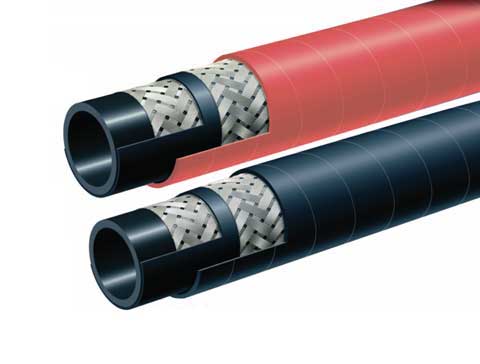
Specialized piping solutions for immersion fluorinated fluid applications typically feature internal diameters ranging from 10 mm to 20 mm, minimum bend radii of 50 mm to 100 mm, and maximum operating pressures of up to 2.5 MPa. Some solutions utilize a modified PTFE corrugated structure; this maintains chemical inertness while providing excellent flexibility and kink resistance, ensuring stable long-term operation across a wide temperature range (-60°C to +260°C) with superior aging resistance and extended service life. An outer reinforcement layer—typically stainless steel braiding or mesh—provides additional mechanical protection and pressure-bearing capacity, while shielding the inner PTFE tube from external abrasion. End connections require sealing materials compatible with fluorinated fluids (such as PTFE or Kalrez perfluoroelastomer) to prevent leakage risks caused by seal swelling.
In summary, PTFE-lined immersion cooling hoses perfectly meet the systematic requirements of immersion cooling systems—specifically resistance to fluorinated fluids, zero contamination, and long service life—thanks to three core technical attributes: the extreme chemical inertness of the carbon-fluorine molecular structure, adaptability to two-phase operating conditions across a wide temperature range (-60°C to 260°C), and cleanliness assurance characterized by ultra-low permeability and zero leaching. From the cautionary 3.874% volumetric shrinkage of EPDM in fluorinated fluids to the contrast offered by the near-total inertness of PTFE—and spanning requirements from single-phase immersion compatibility to the ability to withstand the alternating liquid-vapor conditions of two-phase immersion—every aspect of the PTFE liner design targets a single goal: providing a reliable coolant pathway that ensures no corrosion, leaching, or failure for high-value computing equipment within fully immersed liquid-cooling cabinets.
In immersion liquid cooling systems, server motherboards, chips, and cables are fully submerged in a fluorinated cooling fluid. Fluorinated fluids exhibit extremely high chemical permeability; consequently, standard rubber hoses in this environment swell and leach plasticizers within weeks. Dislodged particles can circulate with the coolant into chip microchannels, posing a direct threat to the safety of high-value computing equipment. PTFE-lined hoses designed for immersion cooling offer a specialized solution for this medium: their carbon-fluorine molecular structure ensures near-universal chemical inertness; an operating temperature range of -60°C to +260°C accommodates both single-phase and two-phase fluorinated fluid conditions; and their extremely low permeability prevents the leakage of expensive coolant. Thus, they serve as reliable conduits—resistant to fluorinated fluids, free from leaching, and durable—within immersion cooling systems.
I. Material Selection Logic for Fluorinated Fluids: Why EPDM Requires Caution in Immersion Applications
While fluorinated fluids (such as perfluorocarbons and hydrofluoroethers) are chemically extremely stable, their permeability regarding polymer materials far exceeds that of water or glycol. Academic research indicates that after 96 hours of immersion in fluorinated fluid at 150°C, EPDM exhibits a volume shrinkage of 3.874%—the most severe volumetric change among all tested materials. This phenomenon occurs because the fluorinated fluid extracts low-molecular-weight additives (such as plasticizers and antioxidants) from the EPDM, causing the material to densify while undergoing irreversible changes in mechanical properties.
Industry material compatibility guidelines provide a clear conclusion: materials with poor compatibility with fluorinated fluids (specifically PFPE types) include natural rubber, butadiene rubber (BR), and fluoroelastomer (FKM). EPDM is classified as requiring "caution" in fluorinated fluid applications; prolonged contact can lead to hardening and brittle cracking due to plasticizer leaching, limiting its use to external, non-contact structural components. This implies that for immersion liquid cooling systems, the selection of piping materials in direct contact with fluorinated fluids must move beyond the material systems typically used in cold-plate liquid cooling.
II. The Advantages of PTFE’s "Chemical Inertness": From Molecular Structure to Full Lifecycle
PTFE (polytetrafluoroethylene) has become the industry's preferred choice for immersion cooling applications involving fluorinated fluids, a status rooted in the exceptional stability of its carbon-fluorine bonds. The carbon-fluorine bond is one of the strongest single bonds in organic chemistry; its dense "electronic protective shield" renders it virtually unreactive with almost all chemical molecules.
In specific immersion liquid cooling applications, PTFE demonstrates multifaceted technical advantages. Regarding chemical compatibility, PTFE is virtually inert to media such as fluorinated fluids and perfluoropolyethers; it does not swell, degrade, or leach plasticizers or antioxidants, thereby fundamentally avoiding the failure modes—such as volume shrinkage and plasticizer loss—that EPDM experiences in high-temperature fluorinated fluids. In terms of temperature adaptability, PTFE operates within a range of -200°C to +260°C, with a short-term heat resistance of up to 300°C, meeting the thermal fluctuation demands of the boiling-condensation cycle inherent in two-phase immersion cooling. Regarding permeability, PTFE exhibits an extremely low helium leakage rate, effectively preventing the slow seepage of expensive fluorinated fluids and reducing long-term coolant replenishment costs for data centers. In terms of cleanliness, PTFE features a smooth, non-stick inner surface that prevents particle deposition and scaling, ensuring the long-term, clean circulation of coolant through chip microchannels.
Industry data indicates a clear technological divergence: while EPDM remains the mainstream material for conventional water/glycol cold-plate liquid cooling, PTFE is the industry standard for scenarios involving immersion in fluorinated fluids, high-temperature operation, and long service-life requirements—such as in supercomputing and high-density AI computing environments. III. Adaptation for Immersion Cooling Scenarios: Specialized Piping Solutions for Single-Phase and Two-Phase Systems
Hose requirements for immersion liquid cooling systems vary depending on the technical approach. In single-phase immersion systems, servers are directly submerged in fluorinated fluid, and the coolant circulates in a liquid state; this places the highest demands on the hose's chemical compatibility and cleanliness. In two-phase immersion systems, the fluorinated fluid boils and vaporizes at the chip surface, with the vapor returning via a condenser; consequently, the piping must withstand alternating contact with both liquid and gaseous fluorinated fluid, imposing additional requirements for low permeability and thermal stability.
Specialized piping solutions for immersion fluorinated fluid applications typically feature internal diameters ranging from 10 mm to 20 mm, minimum bend radii of 50 mm to 100 mm, and maximum operating pressures of up to 2.5 MPa. Some solutions utilize a modified PTFE corrugated structure; this maintains chemical inertness while providing excellent flexibility and kink resistance, ensuring stable long-term operation across a wide temperature range (-60°C to +260°C) with superior aging resistance and extended service life. An outer reinforcement layer—typically stainless steel braiding or mesh—provides additional mechanical protection and pressure-bearing capacity, while shielding the inner PTFE tube from external abrasion. End connections require sealing materials compatible with fluorinated fluids (such as PTFE or Kalrez perfluoroelastomer) to prevent leakage risks caused by seal swelling.
In summary, PTFE-lined immersion cooling hoses perfectly meet the systematic requirements of immersion cooling systems—specifically resistance to fluorinated fluids, zero contamination, and long service life—thanks to three core technical attributes: the extreme chemical inertness of the carbon-fluorine molecular structure, adaptability to two-phase operating conditions across a wide temperature range (-60°C to 260°C), and cleanliness assurance characterized by ultra-low permeability and zero leaching. From the cautionary 3.874% volumetric shrinkage of EPDM in fluorinated fluids to the contrast offered by the near-total inertness of PTFE—and spanning requirements from single-phase immersion compatibility to the ability to withstand the alternating liquid-vapor conditions of two-phase immersion—every aspect of the PTFE liner design targets a single goal: providing a reliable coolant pathway that ensures no corrosion, leaching, or failure for high-value computing equipment within fully immersed liquid-cooling cabinets.
Previous: