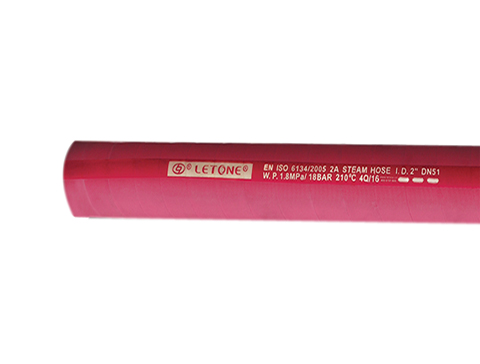
Double layered steel wire braided reinforced liquid cooled hose with a burst pressure of 8MPa and stable high pulse working conditions
release date:2026-10-08 09:30:01
reading volume:
share:
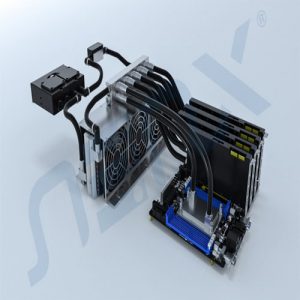 In the liquid cooling systems of AI computing clusters, hoses are subjected not to constant pressure, but to continuous pressure pulsations caused by the periodic action of cooling pumps and load adjustments. The fatigue damage inflicted on the reinforcement layer by such long-term cyclic loading is far more insidious and critical than that caused by a single pressure shock; should the braided layer delaminate or rupture after millions of pressure fluctuations, a coolant leak would directly jeopardize the safety of high-value GPU clusters. Liquid cooling hoses reinforced with double-layer steel wire braiding offer a specialized solution for these demanding fatigue conditions: they utilize an interleaved double-layer steel wire structure to create an "anti-fatigue skeleton," provide ample safety margins with an 8 MPa burst pressure, and ensure stable system operation throughout its entire lifecycle, backed by proven high-pulse durability.
I. The Mechanics of Pressure Pulsation Damage: Why High-Pulse Conditions Demand Greater Safety Margins
Liquid cooling systems operate in environments where piping is particularly sensitive to pressure pulsations. Periodic fluid surges generated by cooling pumps, combined with the frequent actuation of flow control valves driven by volatile AI workloads, create continuous pressure fluctuations within the secondary loop. Unlike instantaneous water hammer shocks, pressure pulsations involve long-term, repetitive pressure variations; over millions of cycles, these can lead to fatigue fractures in the reinforcement wires or the propagation of micro-cracks at the interlaminar bonding interfaces.
In standard single-layer braided hoses subjected to such high-frequency pulsations, the alternating stress experienced by the reinforcement wires concentrates at the braid crossover points, significantly shortening the hose's fatigue life due to cumulative stress. To meet the requirement that liquid cooling systems maintain an annual failure rate below 0.3%, critical components like hoses must demonstrate a pulse fatigue life exceeding 500,000 cycles, thereby satisfying the system's service life requirement of over six years.
II. Double-Layer Steel Wire Braiding: A Leap in Fatigue Resistance from Single to Double Layers
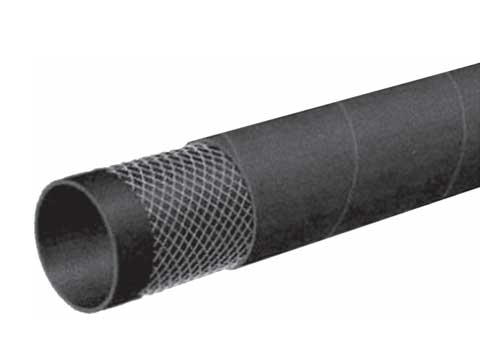
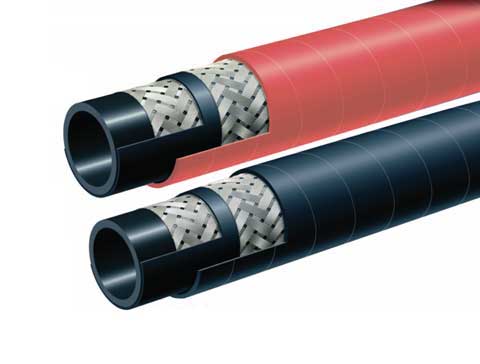
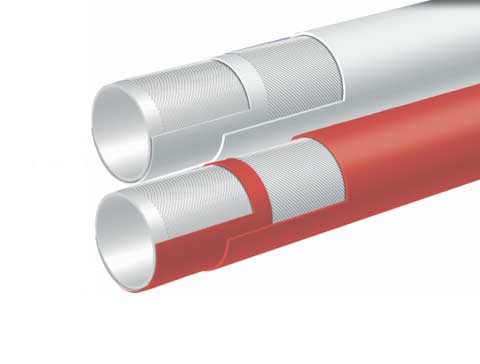
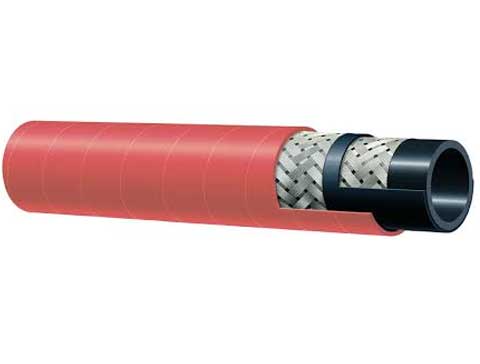
A double-layer steel wire reinforcement structure serves as the core foundation for achieving high pulse durability. Compared to single-layer braiding (1SN), double-layer braiding (2SN/2ST) enhances both pressure-bearing capacity and fatigue resistance by adding a second layer of high-strength steel wire.
The two layers of steel wire are precisely braided in alternating directions to form a "cross-interlocked" framework. When the hose is subjected to internal pressure, the two wire layers work in tandem to constrain radial expansion: the inner layer primarily resists bulging deformation, while the outer layer inhibits excessive elongation. This ensures stress is evenly distributed between the layers, preventing the accelerated fatigue failure caused by localized stress concentrations often seen in single-layer structures under high-pressure pulses. The layers are firmly bonded by a high-adhesion intermediate rubber layer, ensuring no interlayer slippage or delamination occurs during frequent pressure cycling.
A burst pressure rating of 8 MPa corresponds to a working pressure of approximately 2.0 MPa, yielding a 4:1 safety factor. This generous burst margin provides ample buffer for transient overpressure events under abnormal operating conditions; for instance, the startup of a cooling pump can generate instantaneous pressure peaks two to three times higher than normal operating pressure, and the 4:1 margin ensures such shocks do not trigger hose failure. Furthermore, since the burst pressure of EPDM materials declines over time due to thermo-oxidative aging and coolant immersion, the initial 4:1 margin guarantees a sufficient safety buffer even at the end of the material's service life.
Regarding pulse life, high-quality double-layer braided hoses can withstand over 500,000 pressure pulse cycles. While industry standards for liquid cooling hoses typically require passing 250,000 pressure pulse cycles and high/low-temperature cycling tests, high-performance products often exceed these requirements by more than double, providing substantial fatigue life redundancy for liquid cooling systems operating continuously (24/7).
III. Adaptation to Liquid Cooling Scenarios: From Material Purity to System Integration
The reliability of double-layer steel-wire braided liquid cooling hoses under high-pulse conditions also depends on the media compatibility of the inner layer material and the system integration of the end connections. Regarding the inner layer material, EPDM (ethylene propylene diene monomer) rubber—thanks to its saturated molecular chain structure—exhibits excellent chemical inertness toward 20%–30% ethylene glycol or propylene glycol aqueous coolants. By utilizing a peroxide curing system instead of the traditional sulfur-based method (which requires zinc oxide), the risk of zinc salt leaching and contaminating the coolant is fundamentally eliminated. With zero zinc, aluminum, and halogen content in the inner rubber layer, the coolant's electrical conductivity remains stable during long-term operation, preventing ion leaching from accelerating scale formation within the cold plate's micro-channels.
The operating temperature range spans -40°C to +120°C, meeting the requirements of liquid cooling systems across all scenarios—from cold-start conditions in winter to high-temperature operation under full GPU load. The outer rubber layer is UL94 V-0 flame-retardant certified, providing passive fire safety in densely packed electrical cabinet environments.
End connections are critical to the hose's performance. Both ends come pre-fitted with OCP-compliant quick-disconnect couplings (UQD) featuring EPDM seals and red/blue color-coding for supply and return lines; these support "one-handed, rapid connection" and "dry-break" functionality, ensuring zero coolant leakage during mating and unmating. During installation, the bending radius must not fall below the rated value to avoid stress concentration in the dual-braid reinforcement caused by sharp bends, which could compromise resistance to pulse fatigue.
In summary, this liquid cooling hose—featuring double-layer steel wire reinforcement and an 8 MPa burst pressure—perfectly aligns with the systematic requirements of AI computing liquid cooling systems for stability under high-pulse conditions and long-term leak-free operation. It achieves this through three core technical strengths: a "cross-interlocked" anti-fatigue framework formed by the dual-layer staggered braid, a generous safety margin with a 4:1 burst-to-operating pressure ratio, and long-term reliability demonstrated by a pulse life exceeding 500,000 cycles. From the uniform stress distribution of the dual-layer braid to the safety margin provided by an 8 MPa burst pressure, and from the compliance benchmark of 250,000 impulse cycles to a performance redundancy exceeding 500,000 cycles—every layer of wire braiding and every crimping process is dedicated to a single goal: ensuring reliable, fatigue-free, leak-proof, and failure-free operation for high-value computing equipment within liquid cooling circuits characterized by continuous pump pulsation and drastic load fluctuations.
In the liquid cooling systems of AI computing clusters, hoses are subjected not to constant pressure, but to continuous pressure pulsations caused by the periodic action of cooling pumps and load adjustments. The fatigue damage inflicted on the reinforcement layer by such long-term cyclic loading is far more insidious and critical than that caused by a single pressure shock; should the braided layer delaminate or rupture after millions of pressure fluctuations, a coolant leak would directly jeopardize the safety of high-value GPU clusters. Liquid cooling hoses reinforced with double-layer steel wire braiding offer a specialized solution for these demanding fatigue conditions: they utilize an interleaved double-layer steel wire structure to create an "anti-fatigue skeleton," provide ample safety margins with an 8 MPa burst pressure, and ensure stable system operation throughout its entire lifecycle, backed by proven high-pulse durability.
I. The Mechanics of Pressure Pulsation Damage: Why High-Pulse Conditions Demand Greater Safety Margins
Liquid cooling systems operate in environments where piping is particularly sensitive to pressure pulsations. Periodic fluid surges generated by cooling pumps, combined with the frequent actuation of flow control valves driven by volatile AI workloads, create continuous pressure fluctuations within the secondary loop. Unlike instantaneous water hammer shocks, pressure pulsations involve long-term, repetitive pressure variations; over millions of cycles, these can lead to fatigue fractures in the reinforcement wires or the propagation of micro-cracks at the interlaminar bonding interfaces.
In standard single-layer braided hoses subjected to such high-frequency pulsations, the alternating stress experienced by the reinforcement wires concentrates at the braid crossover points, significantly shortening the hose's fatigue life due to cumulative stress. To meet the requirement that liquid cooling systems maintain an annual failure rate below 0.3%, critical components like hoses must demonstrate a pulse fatigue life exceeding 500,000 cycles, thereby satisfying the system's service life requirement of over six years.
II. Double-Layer Steel Wire Braiding: A Leap in Fatigue Resistance from Single to Double Layers
A double-layer steel wire reinforcement structure serves as the core foundation for achieving high pulse durability. Compared to single-layer braiding (1SN), double-layer braiding (2SN/2ST) enhances both pressure-bearing capacity and fatigue resistance by adding a second layer of high-strength steel wire.
The two layers of steel wire are precisely braided in alternating directions to form a "cross-interlocked" framework. When the hose is subjected to internal pressure, the two wire layers work in tandem to constrain radial expansion: the inner layer primarily resists bulging deformation, while the outer layer inhibits excessive elongation. This ensures stress is evenly distributed between the layers, preventing the accelerated fatigue failure caused by localized stress concentrations often seen in single-layer structures under high-pressure pulses. The layers are firmly bonded by a high-adhesion intermediate rubber layer, ensuring no interlayer slippage or delamination occurs during frequent pressure cycling.
A burst pressure rating of 8 MPa corresponds to a working pressure of approximately 2.0 MPa, yielding a 4:1 safety factor. This generous burst margin provides ample buffer for transient overpressure events under abnormal operating conditions; for instance, the startup of a cooling pump can generate instantaneous pressure peaks two to three times higher than normal operating pressure, and the 4:1 margin ensures such shocks do not trigger hose failure. Furthermore, since the burst pressure of EPDM materials declines over time due to thermo-oxidative aging and coolant immersion, the initial 4:1 margin guarantees a sufficient safety buffer even at the end of the material's service life.
Regarding pulse life, high-quality double-layer braided hoses can withstand over 500,000 pressure pulse cycles. While industry standards for liquid cooling hoses typically require passing 250,000 pressure pulse cycles and high/low-temperature cycling tests, high-performance products often exceed these requirements by more than double, providing substantial fatigue life redundancy for liquid cooling systems operating continuously (24/7).
III. Adaptation to Liquid Cooling Scenarios: From Material Purity to System Integration
The reliability of double-layer steel-wire braided liquid cooling hoses under high-pulse conditions also depends on the media compatibility of the inner layer material and the system integration of the end connections. Regarding the inner layer material, EPDM (ethylene propylene diene monomer) rubber—thanks to its saturated molecular chain structure—exhibits excellent chemical inertness toward 20%–30% ethylene glycol or propylene glycol aqueous coolants. By utilizing a peroxide curing system instead of the traditional sulfur-based method (which requires zinc oxide), the risk of zinc salt leaching and contaminating the coolant is fundamentally eliminated. With zero zinc, aluminum, and halogen content in the inner rubber layer, the coolant's electrical conductivity remains stable during long-term operation, preventing ion leaching from accelerating scale formation within the cold plate's micro-channels.
The operating temperature range spans -40°C to +120°C, meeting the requirements of liquid cooling systems across all scenarios—from cold-start conditions in winter to high-temperature operation under full GPU load. The outer rubber layer is UL94 V-0 flame-retardant certified, providing passive fire safety in densely packed electrical cabinet environments.
End connections are critical to the hose's performance. Both ends come pre-fitted with OCP-compliant quick-disconnect couplings (UQD) featuring EPDM seals and red/blue color-coding for supply and return lines; these support "one-handed, rapid connection" and "dry-break" functionality, ensuring zero coolant leakage during mating and unmating. During installation, the bending radius must not fall below the rated value to avoid stress concentration in the dual-braid reinforcement caused by sharp bends, which could compromise resistance to pulse fatigue.
In summary, this liquid cooling hose—featuring double-layer steel wire reinforcement and an 8 MPa burst pressure—perfectly aligns with the systematic requirements of AI computing liquid cooling systems for stability under high-pulse conditions and long-term leak-free operation. It achieves this through three core technical strengths: a "cross-interlocked" anti-fatigue framework formed by the dual-layer staggered braid, a generous safety margin with a 4:1 burst-to-operating pressure ratio, and long-term reliability demonstrated by a pulse life exceeding 500,000 cycles. From the uniform stress distribution of the dual-layer braid to the safety margin provided by an 8 MPa burst pressure, and from the compliance benchmark of 250,000 impulse cycles to a performance redundancy exceeding 500,000 cycles—every layer of wire braiding and every crimping process is dedicated to a single goal: ensuring reliable, fatigue-free, leak-proof, and failure-free operation for high-value computing equipment within liquid cooling circuits characterized by continuous pump pulsation and drastic load fluctuations.
Previous: