API 7K ultra wear-resistant hydraulic fracturing hose UPE inner layer acid corrosion resistant conveying high-pressure fracturing fluid and proppant
release date:2026-08-07 15:17:12
reading volume:
share:
Hydraulic fracturing is the core technology for releasing reservoir productivity in unconventional oil and gas development such as shale gas and tight oil. This process requires injecting sand carrying fracturing fluid into the formation under ultra-high pressure of over 100MPa, creating a gas flowing fracture network in the rock formation. The fracturing fluid not only contains high hardness proppants such as quartz sand and ceramic particles (with a content of up to 30%), but also strong corrosive chemical additives such as acid and crosslinking agents, which cause a dual impact of "abrasive wear" and "chemical erosion" on the conveying pipeline. The API 7K standard UPE lined ultra wear-resistant fracturing hose is a solution for this extreme working condition - using UPE (ultra-high molecular weight polyethylene) lining to construct a wear-resistant and acid resistant "dual resistance barrier", using multi-layer high-strength steel wire winding to bear extreme pressure, and using a wear warning layer to achieve full life cycle safety management, becoming an indispensable "flexible artery" in shale gas fracturing operations.
 1、 UPE lining: a "dual resistance barrier" of wear resistance and acid resistance
The damage mechanism of fracturing fluid on the inner wall of the hose includes two dimensions. One is abrasive wear - the proppant particles (quartz sand, ceramic particles) are driven by high pressure to scour the inner wall at a speed of several meters to more than ten meters per second. Its failure mechanism belongs to typical liquid-solid two-phase flow erosion, and the flow velocity is the most important factor in the increase of erosion rate. The second is chemical corrosion - media such as hydrochloric acid (concentration 15% -28%) and hydrofluoric acid commonly used in acid fracturing have strong swelling and corrosive effects on ordinary rubber.
UPE (ultra-high molecular weight polyethylene) lining is a material innovation that addresses this dual blow. The molecular weight of UPE is as high as millions, and its wear resistance is 6-7 times that of ordinary rubber. Under extreme conditions with a sand content of 30%, the service life of UPE lining can reach over 2000 hours. In terms of chemical corrosion resistance, UPE has excellent resistance to strong acid and alkali media with pH values of 1-14, and can safely transport hydrochloric acid, hydrofluoric acid, and various acid based fracturing fluids.
The technological upgrade of UPE lining is reflected in the formulation of composite materials. The patented technology blends UPE with high-density polyethylene and polyolefin elastomer (POE), which not only improves the processing performance of UPE, but also enhances the aging resistance, impact resistance, and chemical medium resistance of the inner lining layer; The addition of polyimide, mica powder, and bentonite further enhances the wear resistance, acid and alkali resistance, and bonding strength of the inner lining layer with the reinforcement layer. Some products also offer UPE+HNBR composite inner lining solutions, which balance temperature and corrosion resistance requirements in extreme high temperature or sulfur-containing medium scenarios.
2、 Multi layer steel wire reinforcement: a "mechanical skeleton" that bears extreme pressure
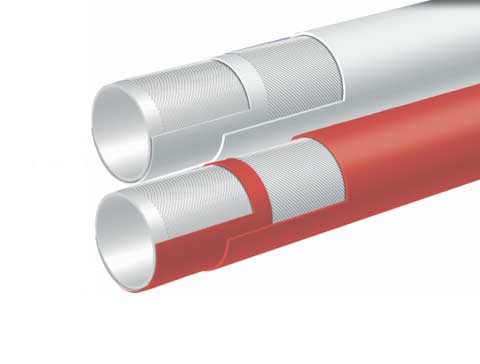
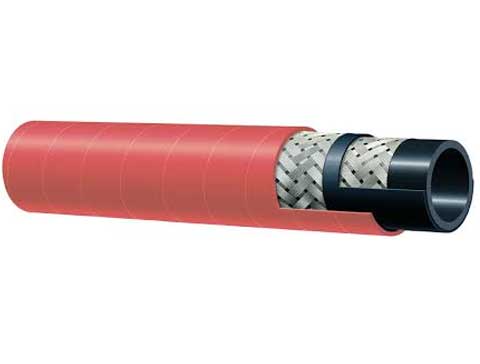
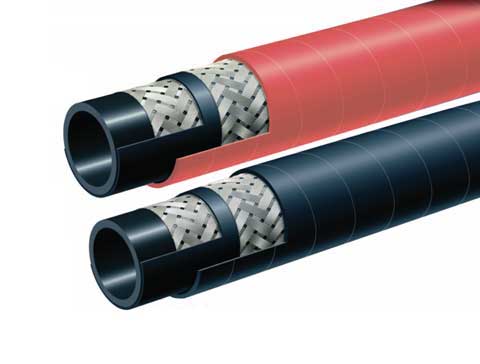
The UPE lining provides a chemical barrier, but the core pressure bearing of the fracturing operation still needs to be completed by the reinforcement layer. The reinforcement layer of API 7K fracturing hose adopts a 4-6 layer high-strength steel wire spiral winding structure, forming a mechanical skeleton that combines rigidity and flexibility.
The mechanical logic of 4-6 layer steel wire lies in "layered bearing and collaborative deformation". The inner steel wire provides radial support at a higher winding angle to resist the bulging deformation of the pipe body under high pressure; The outer steel wire constructs an axial tensile skeleton at a lower angle to withstand the tensile load generated by the instantaneous impact of the fracturing pump. The layers are formed into a strong whole through a high adhesion formula, which collaboratively deforms under pulse loads to avoid interlayer delamination.
The API 7K standard sets strict thresholds for safety redundancy of fracturing hoses. According to the selection guide, API 7K hoses can be classified into three pressure levels: 5000psi (conventional fracturing), 10000psi (deep shale gas), and 15000psi (ultra deep well). The burst pressure is 4 times the working pressure, and the pulse test requires cycling at high pressure for more than 5000 times without failure. The UPE lined fracturing hose of LT301 F series from Litong Technology has a temperature range of -29 ℃ to+100 ℃, and adopts integral union or integral flange joints to meet the diverse operational needs of shale gas fields worldwide.
3、 Fracturing scene adaptation: from wear warning to full cycle safety
The practical value of UPE lined fracturing hoses in shale gas fracturing operations is also reflected in two dimensions: "visual life management" and "efficient on-site deployment".
The wear warning layer design solves the industry problem of "when to replace" fracturing hoses. A colored warning layer is integrated below the inner lining of the hose - when the inner UPE wears to a critical value, the red warning layer appears, and the operator can visually and intuitively judge the remaining life of the hose, achieving a leap from "passive burst" to "active warning". This design is particularly critical in hydraulic fracturing operations with high sand content - when the proppant concentration increases from 40kg/m ³ to 210kg/m ³, the erosion rate increases approximately linearly, and the maximum erosion rate can increase by 2.3 times. The wear warning layer provides a quantifiable management basis for on-site safety.
Flexible tubing and efficiency improvement are another core advantage of API 7K fracturing hoses replacing traditional steel pipes. Steel pipe connections require a large number of flexible elbows and flanges, making the installation process cumbersome and time-consuming; The flexible hose, when combined with an integral union or flange joint, can achieve quick connection and deployment. Based on the calculation of zipper operation in 4 wells, the number of high-pressure pipe valves for flexible fracturing hoses is only one-third of that of conventional steel pipe connections. The number of on-site connection points is reduced by about 70%, the connection time of the manifold is reduced by about 50%, and the equipment cost is saved by about 41.2%.
In terms of end connections, API 7K fracturing hoses are usually equipped with integral union or integral flange joints, which are made of high-strength alloy steel and combined with the pipe body through CNC crimping technology. The crimping accuracy is controlled within ± 0.01mm, ensuring that no detachment or leakage occurs under pulse pressure above 15000psi. The product has passed API 7K FSL0 certification and ABS classification society certification. Each hose is equipped with a unique traceability code to achieve full lifecycle quality monitoring.
In summary, the API 7K standard UPE lined ultra wear-resistant fracturing hose perfectly meets the strict requirements of shale gas fracturing operations for "wear resistance, corrosion resistance, pulse resistance, and long life" with its UPE lined "dual resistance" barrier, 4-6 layers of steel wire reinforced extreme pressure bearing, and full life cycle safety management of wear warning layer. From a service life of 2000 hours under the condition of 30% sand content to a 4-fold blasting redundancy of 15000psi, from the "visual" warning of the red warning layer to the 50% time saving of flexible pipe laying, every technical detail points to the same goal: to provide a safe, reliable, and durable flexible channel for efficient transportation of fracturing fluid and proppant in the underground rock transformation of thousands of meters.
1、 UPE lining: a "dual resistance barrier" of wear resistance and acid resistance
The damage mechanism of fracturing fluid on the inner wall of the hose includes two dimensions. One is abrasive wear - the proppant particles (quartz sand, ceramic particles) are driven by high pressure to scour the inner wall at a speed of several meters to more than ten meters per second. Its failure mechanism belongs to typical liquid-solid two-phase flow erosion, and the flow velocity is the most important factor in the increase of erosion rate. The second is chemical corrosion - media such as hydrochloric acid (concentration 15% -28%) and hydrofluoric acid commonly used in acid fracturing have strong swelling and corrosive effects on ordinary rubber.
UPE (ultra-high molecular weight polyethylene) lining is a material innovation that addresses this dual blow. The molecular weight of UPE is as high as millions, and its wear resistance is 6-7 times that of ordinary rubber. Under extreme conditions with a sand content of 30%, the service life of UPE lining can reach over 2000 hours. In terms of chemical corrosion resistance, UPE has excellent resistance to strong acid and alkali media with pH values of 1-14, and can safely transport hydrochloric acid, hydrofluoric acid, and various acid based fracturing fluids.
The technological upgrade of UPE lining is reflected in the formulation of composite materials. The patented technology blends UPE with high-density polyethylene and polyolefin elastomer (POE), which not only improves the processing performance of UPE, but also enhances the aging resistance, impact resistance, and chemical medium resistance of the inner lining layer; The addition of polyimide, mica powder, and bentonite further enhances the wear resistance, acid and alkali resistance, and bonding strength of the inner lining layer with the reinforcement layer. Some products also offer UPE+HNBR composite inner lining solutions, which balance temperature and corrosion resistance requirements in extreme high temperature or sulfur-containing medium scenarios.
2、 Multi layer steel wire reinforcement: a "mechanical skeleton" that bears extreme pressure
The UPE lining provides a chemical barrier, but the core pressure bearing of the fracturing operation still needs to be completed by the reinforcement layer. The reinforcement layer of API 7K fracturing hose adopts a 4-6 layer high-strength steel wire spiral winding structure, forming a mechanical skeleton that combines rigidity and flexibility.
The mechanical logic of 4-6 layer steel wire lies in "layered bearing and collaborative deformation". The inner steel wire provides radial support at a higher winding angle to resist the bulging deformation of the pipe body under high pressure; The outer steel wire constructs an axial tensile skeleton at a lower angle to withstand the tensile load generated by the instantaneous impact of the fracturing pump. The layers are formed into a strong whole through a high adhesion formula, which collaboratively deforms under pulse loads to avoid interlayer delamination.
The API 7K standard sets strict thresholds for safety redundancy of fracturing hoses. According to the selection guide, API 7K hoses can be classified into three pressure levels: 5000psi (conventional fracturing), 10000psi (deep shale gas), and 15000psi (ultra deep well). The burst pressure is 4 times the working pressure, and the pulse test requires cycling at high pressure for more than 5000 times without failure. The UPE lined fracturing hose of LT301 F series from Litong Technology has a temperature range of -29 ℃ to+100 ℃, and adopts integral union or integral flange joints to meet the diverse operational needs of shale gas fields worldwide.
3、 Fracturing scene adaptation: from wear warning to full cycle safety
The practical value of UPE lined fracturing hoses in shale gas fracturing operations is also reflected in two dimensions: "visual life management" and "efficient on-site deployment".
The wear warning layer design solves the industry problem of "when to replace" fracturing hoses. A colored warning layer is integrated below the inner lining of the hose - when the inner UPE wears to a critical value, the red warning layer appears, and the operator can visually and intuitively judge the remaining life of the hose, achieving a leap from "passive burst" to "active warning". This design is particularly critical in hydraulic fracturing operations with high sand content - when the proppant concentration increases from 40kg/m ³ to 210kg/m ³, the erosion rate increases approximately linearly, and the maximum erosion rate can increase by 2.3 times. The wear warning layer provides a quantifiable management basis for on-site safety.
Flexible tubing and efficiency improvement are another core advantage of API 7K fracturing hoses replacing traditional steel pipes. Steel pipe connections require a large number of flexible elbows and flanges, making the installation process cumbersome and time-consuming; The flexible hose, when combined with an integral union or flange joint, can achieve quick connection and deployment. Based on the calculation of zipper operation in 4 wells, the number of high-pressure pipe valves for flexible fracturing hoses is only one-third of that of conventional steel pipe connections. The number of on-site connection points is reduced by about 70%, the connection time of the manifold is reduced by about 50%, and the equipment cost is saved by about 41.2%.
In terms of end connections, API 7K fracturing hoses are usually equipped with integral union or integral flange joints, which are made of high-strength alloy steel and combined with the pipe body through CNC crimping technology. The crimping accuracy is controlled within ± 0.01mm, ensuring that no detachment or leakage occurs under pulse pressure above 15000psi. The product has passed API 7K FSL0 certification and ABS classification society certification. Each hose is equipped with a unique traceability code to achieve full lifecycle quality monitoring.
In summary, the API 7K standard UPE lined ultra wear-resistant fracturing hose perfectly meets the strict requirements of shale gas fracturing operations for "wear resistance, corrosion resistance, pulse resistance, and long life" with its UPE lined "dual resistance" barrier, 4-6 layers of steel wire reinforced extreme pressure bearing, and full life cycle safety management of wear warning layer. From a service life of 2000 hours under the condition of 30% sand content to a 4-fold blasting redundancy of 15000psi, from the "visual" warning of the red warning layer to the 50% time saving of flexible pipe laying, every technical detail points to the same goal: to provide a safe, reliable, and durable flexible channel for efficient transportation of fracturing fluid and proppant in the underground rock transformation of thousands of meters.
Previous: