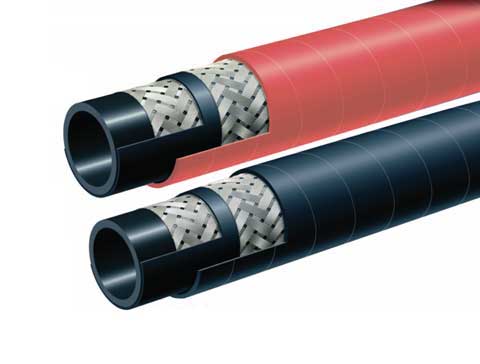
API 16C stainless steel armored flexible pipeline FSL3 highest flexibility level suitable for semi submersible drilling platforms
release date:2026-08-07 15:24:39
reading volume:
share:
In deepwater oil and gas drilling, semi submersible drilling platforms are not fixed "steel islands", but floating structures that continue to move with waves and currents. The riser system connecting the platform to the underwater wellhead, as well as the flexible pipeline connecting the riser to the choke and kill manifold, must remain reliable during the dynamic displacement of platform heave, roll, and pitch. Ordinary hard pipelines are prone to fracture due to stress concentration under such working conditions, and the API 16C standard FSL3 highest flexibility grade stainless steel armored flexible pipeline is the solution for this extreme dynamic working condition - ensuring high-frequency bending adaptability under small bending radius with FSL3 grade, providing physical protection against wear and impact with stainless steel armor, and building the last line of safety defense with 704 ℃ × 30 minutes fire resistance performance, becoming an indispensable "flexible artery" in the well control system of semi submersible drilling platforms.
1、 FSL3 highest flexibility level: "flexibility code" under dynamic displacement
API Spec. 16C is an internationally recognized performance evaluation standard for throttling and well killing hoses in the petroleum industry. This standard divides hoses into four levels of flexibility: FSL 0, FSL 1, FSL 2, and FSL 3. Among them, FSL 3 is the highest flexibility level, designed for complex working conditions such as drilling platforms, semi submersible drilling vessels, or drilling vessels with relative motion and changes in installation dimensions. Under the action of wind and waves, semi submersible drilling platforms will experience continuous uplift and subsidence movements - the relative displacement between the platform and the underwater blowout preventer may reach several meters, and flexible pipelines must maintain structural integrity under continuous changes in sea conditions. FSL Level 3 optimizes the winding angle of the reinforcement layer and the interlayer bonding process, allowing the hose to maintain a smooth inner cavity within a very small bending radius, without twisting or collapsing. Taking the 5-inch specification as an example, the minimum bending radius of FSL 3 grade API 16C hose can be controlled at around 1600mm. When the platform swings violently, it absorbs displacement energy through its own elastic deformation, avoiding stress concentration at rigid connection points.
 2、 Stainless steel armor: a "dual effect armor" for mechanical protection and corrosion resistance
The deck and underwater environment of semi submersible drilling platforms pose multiple external threats to flexible hoses: mechanical impacts caused by personnel stepping on the deck, equipment collisions, and tool falls; Dragging anchor chains and rock friction on the seabed; Corrosion of metal components by marine salt spray and acidic media containing H ₂ S.
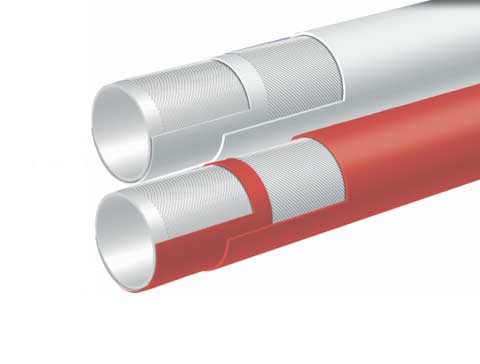
The stainless steel armor outer protective layer is designed to address these threats, resolving them one by one without sacrificing the flexibility of the hose - this is the essence of FSL 3 grade. The stainless steel armor layer is formed by spiral winding high-strength stainless steel strips, forming a hard "metal exoskeleton" that can effectively resist external impact and drag wear. In the throttling and well killing pipeline, the armor layer also plays an additional role in fire prevention assistance - even if the outer rubber layer is burned in a fire, the metal armor can still maintain the shape of the pipe body and prevent the inner structure from being exposed to flames. In addition, stainless steel armor has excellent corrosion resistance to marine salt spray environments. Armors made of 304 or 316L materials can maintain structural integrity for a design life of over 20 years without the need for additional anti-corrosion coatings.
3、 Core parameters and semi submersible platform adaptation
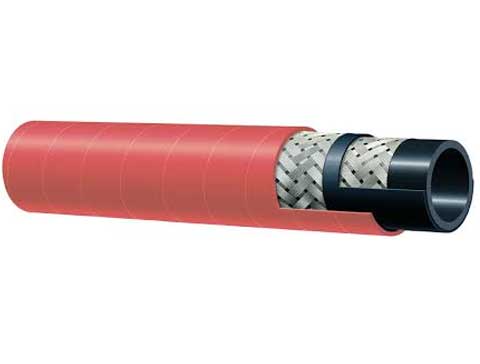
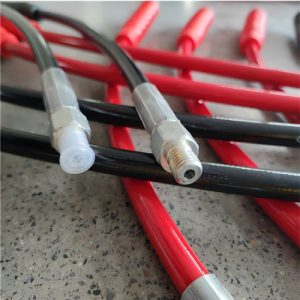
The technical parameters of API 16C stainless steel armored flexible pipelines directly respond to the operational requirements of semi submersible drilling platforms. The hose complies with API Spec. 16C FSL3 and ABS classification society certification. The inner rubber layer is HNBR (hydrogenated nitrile rubber), which has the properties of resistance to H ₂ S, oil and high temperature. It is suitable for transporting oil and gas mixtures containing hydrogen sulfide and other dangerous gases, and various water-based, oil-based and foam kill fluids. The reinforcement layer is made up of 4-6 layers of high-strength ultra flexible steel wire or steel wire rope, providing a working pressure bearing capacity of up to 15000psi. The outer rubber layer is made of high-temperature resistant and fire-resistant synthetic rubber, which can maintain its effectiveness for 30 minutes in an open flame environment at+704 ℃. The outer protective layer is made of stainless steel armor, and the weight of the entire hose varies depending on the diameter and armor configuration - taking the 4-inch 10000psi specification as an example, it is about 52kg/m. This weight needs to be planned in advance for support structures during deck installation and pipe laying. The joint adopts integral union or integral flange, fully compatible with API Spec 6A standard interface, ensuring fast and reliable connection with wellhead blowout preventer and throttling and killing manifold. In addition, the product must also meet the NACE MR0175/ISO 15156 hydrogen sulfide resistance standard, and the joint material must strictly comply with this requirement to ensure that sulfide stress cracking does not occur in harsh environments containing H ₂ S.
In summary, the API 16C stainless steel armored flexible pipeline achieves dynamic displacement adaptation with its highest FSL3 flexibility level, stainless steel armor provides dual protection against mechanical and corrosion, and HNBR lining and fire-resistant outer rubber ensure safe transportation of high-temperature and high-pressure acidic media. These three core technologies perfectly meet the strict requirements of "high flexibility, high protection, and high fire resistance" for the well control system of semi submersible drilling platforms. From the ultimate pressure rating of 15000psi to the fire barrier of 704 ℃× 30 minutes, from the corrosion-resistant design of H ₂ S acidic medium to the extremely small bending radius of FSL3 level, every technical detail points to the same goal: to provide flexible guarantees for well control systems that do not leak, break, or malfunction in the dynamic shaking and potential fire risks of deepwater drilling platforms.
2、 Stainless steel armor: a "dual effect armor" for mechanical protection and corrosion resistance
The deck and underwater environment of semi submersible drilling platforms pose multiple external threats to flexible hoses: mechanical impacts caused by personnel stepping on the deck, equipment collisions, and tool falls; Dragging anchor chains and rock friction on the seabed; Corrosion of metal components by marine salt spray and acidic media containing H ₂ S.
The stainless steel armor outer protective layer is designed to address these threats, resolving them one by one without sacrificing the flexibility of the hose - this is the essence of FSL 3 grade. The stainless steel armor layer is formed by spiral winding high-strength stainless steel strips, forming a hard "metal exoskeleton" that can effectively resist external impact and drag wear. In the throttling and well killing pipeline, the armor layer also plays an additional role in fire prevention assistance - even if the outer rubber layer is burned in a fire, the metal armor can still maintain the shape of the pipe body and prevent the inner structure from being exposed to flames. In addition, stainless steel armor has excellent corrosion resistance to marine salt spray environments. Armors made of 304 or 316L materials can maintain structural integrity for a design life of over 20 years without the need for additional anti-corrosion coatings.
3、 Core parameters and semi submersible platform adaptation
The technical parameters of API 16C stainless steel armored flexible pipelines directly respond to the operational requirements of semi submersible drilling platforms. The hose complies with API Spec. 16C FSL3 and ABS classification society certification. The inner rubber layer is HNBR (hydrogenated nitrile rubber), which has the properties of resistance to H ₂ S, oil and high temperature. It is suitable for transporting oil and gas mixtures containing hydrogen sulfide and other dangerous gases, and various water-based, oil-based and foam kill fluids. The reinforcement layer is made up of 4-6 layers of high-strength ultra flexible steel wire or steel wire rope, providing a working pressure bearing capacity of up to 15000psi. The outer rubber layer is made of high-temperature resistant and fire-resistant synthetic rubber, which can maintain its effectiveness for 30 minutes in an open flame environment at+704 ℃. The outer protective layer is made of stainless steel armor, and the weight of the entire hose varies depending on the diameter and armor configuration - taking the 4-inch 10000psi specification as an example, it is about 52kg/m. This weight needs to be planned in advance for support structures during deck installation and pipe laying. The joint adopts integral union or integral flange, fully compatible with API Spec 6A standard interface, ensuring fast and reliable connection with wellhead blowout preventer and throttling and killing manifold. In addition, the product must also meet the NACE MR0175/ISO 15156 hydrogen sulfide resistance standard, and the joint material must strictly comply with this requirement to ensure that sulfide stress cracking does not occur in harsh environments containing H ₂ S.
In summary, the API 16C stainless steel armored flexible pipeline achieves dynamic displacement adaptation with its highest FSL3 flexibility level, stainless steel armor provides dual protection against mechanical and corrosion, and HNBR lining and fire-resistant outer rubber ensure safe transportation of high-temperature and high-pressure acidic media. These three core technologies perfectly meet the strict requirements of "high flexibility, high protection, and high fire resistance" for the well control system of semi submersible drilling platforms. From the ultimate pressure rating of 15000psi to the fire barrier of 704 ℃× 30 minutes, from the corrosion-resistant design of H ₂ S acidic medium to the extremely small bending radius of FSL3 level, every technical detail points to the same goal: to provide flexible guarantees for well control systems that do not leak, break, or malfunction in the dynamic shaking and potential fire risks of deepwater drilling platforms.
Previous: