API 17K deep-sea adhesive crossover hose with a working pressure of 232 bar is used as a substitute for steel pipes in underwater production systems
release date:2026-08-07 15:30:44
reading volume:
share:
In the development of deep-sea oil and gas fields, the underwater production system forms a complex fluid transport network through subsea manifolds, Christmas trees, and crossover pipes. Traditional steel pipes face a dual dilemma in such scenarios: deep water high pressure and seawater corrosion accelerate the failure of metal pipelines; The relative displacement between the platform and underwater facilities causes stress concentration in the rigid connection. The API 17K adhesive crossover hose is a solution to this contradiction - it uses a multi-layer composite structure to support a working pressure of 232 bar, UPE/PTFE lining to resist acidic medium corrosion, and an integrated vulcanization process to achieve a structural innovation of "replacing rigidity with flexibility". It has become the core flexible equipment connecting Christmas trees and manifolds in underwater production systems, replacing traditional steel pipes.
1、 232 bar pressure rating and API 17K standard system
API Spec 17K is an international standard developed by the American Petroleum Institute specifically for bonding flexible hoses, suitable for scenarios such as flowlines, risers, crossovers, and offshore loading and unloading hoses in deepwater oil and gas fields. This standard covers "sweet and acidic production services" and sets clear technical thresholds for design pressure, medium compatibility, and structural integrity.
 232 bar (approximately 3365 psi) is in the medium to high pressure range in the API 17K pressure system. According to the product technical parameters, the working pressure of the 3-inch caliber hose is 232 bar, the test pressure is 348 bar (1.5 times the working pressure), and the minimum burst pressure is 580 bar (2.5 times the working pressure), with sufficient safety redundancy. This pressure level covers the fluid transportation needs of the vast majority of underwater production systems, including various media such as crude oil, natural gas, water, and injected chemicals.
The API 17K standard requires hoses to undergo a series of type tests, including hydrostatic pressure testing, tensile testing, bending stiffness testing, and pulse fatigue testing, to simulate the service conditions under extreme deep-sea conditions and ensure the structural integrity of the hose during its design life.
2、 Adhesive structure: integrated vulcanized "flexible pressure vessel"
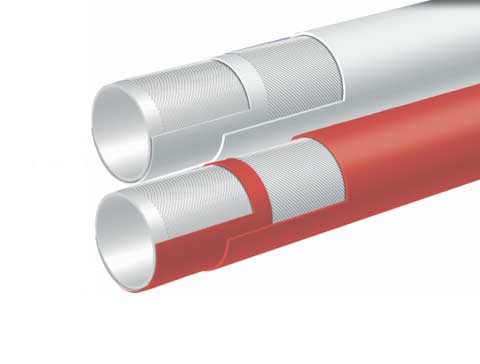
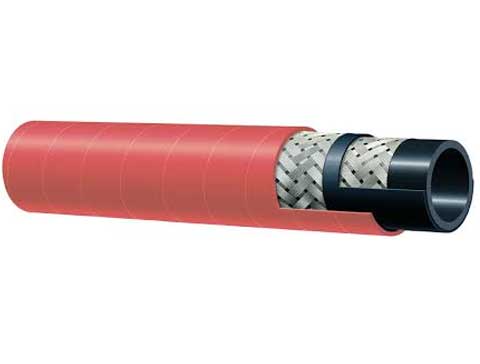
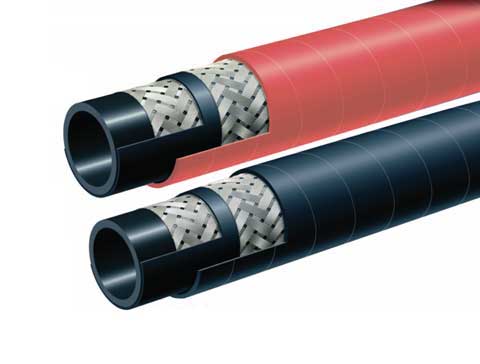
The core technology of replacing steel pipes with jumper hoses lies in their adhesive multi-layer composite structure. Unlike non adhesive hoses with relatively sliding reinforcement layers, API 17K hoses use an integrated vulcanization process to form a chemically cross-linked overall structure of the inner adhesive layer, reinforcement layer, and outer adhesive layer.
The inner lining layer is the first line of defense against medium corrosion. UPE (ultra-high molecular weight polyethylene) lining has a thickness of 4.0mm, and its wear resistance is 4-7 times that of traditional steel. It can withstand long-term corrosion from H ₂ S, CO ₂, and acidic media; PTFE lining is known for its extremely low friction coefficient (0.05-0.10), making it particularly suitable for high viscosity crude oil or media prone to scaling. The reinforcement layer adopts a composite structure of polyester fiber weaving and high-strength ultra flexible copper plated steel wire, and achieves a burst pressure bearing capacity of up to 580 bar through spiral winding technology. The outer rubber layer is made of wear-resistant and weather resistant synthetic rubber, and can be equipped with a stainless steel armor layer to resist deep water seawater immersion and mechanical damage.
The core advantage of this structure lies in the uniform transmission of stress. When the platform is displaced due to waves or ocean currents, the adhesive structure evenly distributes bending, tensile, and torsional loads between layers, avoiding early fatigue failure caused by relative sliding between layers in traditional winding structures.
3、 Adaptation of Underwater Production Systems: Economic and Safety Value of Replacing Steel Pipes
The application value of API 17K crossover hose in underwater production systems is mainly reflected in its multiple benefits of "replacing rigidity with flexibility".
The adaptability to extreme environments has been verified through practical combat. During its service in Wenchang 13-2 Oilfield, the domestically produced API 17K hose successfully withstood the test of the 2024 Super Typhoon "Capricorn" and maintained its sealing performance under extreme conditions with a platform displacement of 2.8 meters.
The economy is significantly better than the steel pipe scheme. Compared to traditional rigid pipelines, the modular design of flexible hoses reduces on-site installation time by more than 60%, and single hose connection operations can be completed within 4 hours, significantly reducing offshore construction costs. The design lifespan is 25 years, during which no structural maintenance is required, reducing maintenance costs by 70% compared to metal pipelines. The price of domestic products has been reduced by 30% -40% compared to similar imported solutions, and has been widely applied in national level projects such as CNOOC Ledong 22-1 gas field.
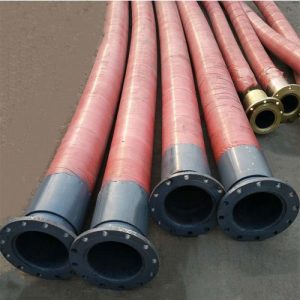
The joint and end connection are also designed with integral union or flange, and the joint material is made of 35CrMo high-strength alloy steel. After integral forging and strict heat treatment, the dimensional accuracy and pressure bearing performance are ensured. The product has passed the API 17K third edition certification and obtained type approval from multiple international classification societies such as CCS, DNV, ABS, etc.
In summary, the API 17K adhesive crossover hose perfectly meets the systematic needs of underwater production systems for "replacing steel pipes, pressure resistance and corrosion resistance, and long service life" with its three core technologies of 232 bar working pressure and 580 bar explosion redundancy, corrosion resistance barrier with UPE/PTFE lining, and interlayer collaborative deformation with integrated vulcanization. From a design lifespan of 25 years to the structural integrity of extreme typhoon conditions, from 4-hour rapid connection to a 70% reduction in maintenance costs, every technical detail points towards the same goal: to provide flexible support for fluid transportation that can withstand pressure shocks and seawater erosion in the dark environment of deepwater oil and gas fields.
232 bar (approximately 3365 psi) is in the medium to high pressure range in the API 17K pressure system. According to the product technical parameters, the working pressure of the 3-inch caliber hose is 232 bar, the test pressure is 348 bar (1.5 times the working pressure), and the minimum burst pressure is 580 bar (2.5 times the working pressure), with sufficient safety redundancy. This pressure level covers the fluid transportation needs of the vast majority of underwater production systems, including various media such as crude oil, natural gas, water, and injected chemicals.
The API 17K standard requires hoses to undergo a series of type tests, including hydrostatic pressure testing, tensile testing, bending stiffness testing, and pulse fatigue testing, to simulate the service conditions under extreme deep-sea conditions and ensure the structural integrity of the hose during its design life.
2、 Adhesive structure: integrated vulcanized "flexible pressure vessel"
The core technology of replacing steel pipes with jumper hoses lies in their adhesive multi-layer composite structure. Unlike non adhesive hoses with relatively sliding reinforcement layers, API 17K hoses use an integrated vulcanization process to form a chemically cross-linked overall structure of the inner adhesive layer, reinforcement layer, and outer adhesive layer.
The inner lining layer is the first line of defense against medium corrosion. UPE (ultra-high molecular weight polyethylene) lining has a thickness of 4.0mm, and its wear resistance is 4-7 times that of traditional steel. It can withstand long-term corrosion from H ₂ S, CO ₂, and acidic media; PTFE lining is known for its extremely low friction coefficient (0.05-0.10), making it particularly suitable for high viscosity crude oil or media prone to scaling. The reinforcement layer adopts a composite structure of polyester fiber weaving and high-strength ultra flexible copper plated steel wire, and achieves a burst pressure bearing capacity of up to 580 bar through spiral winding technology. The outer rubber layer is made of wear-resistant and weather resistant synthetic rubber, and can be equipped with a stainless steel armor layer to resist deep water seawater immersion and mechanical damage.
The core advantage of this structure lies in the uniform transmission of stress. When the platform is displaced due to waves or ocean currents, the adhesive structure evenly distributes bending, tensile, and torsional loads between layers, avoiding early fatigue failure caused by relative sliding between layers in traditional winding structures.
3、 Adaptation of Underwater Production Systems: Economic and Safety Value of Replacing Steel Pipes
The application value of API 17K crossover hose in underwater production systems is mainly reflected in its multiple benefits of "replacing rigidity with flexibility".
The adaptability to extreme environments has been verified through practical combat. During its service in Wenchang 13-2 Oilfield, the domestically produced API 17K hose successfully withstood the test of the 2024 Super Typhoon "Capricorn" and maintained its sealing performance under extreme conditions with a platform displacement of 2.8 meters.
The economy is significantly better than the steel pipe scheme. Compared to traditional rigid pipelines, the modular design of flexible hoses reduces on-site installation time by more than 60%, and single hose connection operations can be completed within 4 hours, significantly reducing offshore construction costs. The design lifespan is 25 years, during which no structural maintenance is required, reducing maintenance costs by 70% compared to metal pipelines. The price of domestic products has been reduced by 30% -40% compared to similar imported solutions, and has been widely applied in national level projects such as CNOOC Ledong 22-1 gas field.
The joint and end connection are also designed with integral union or flange, and the joint material is made of 35CrMo high-strength alloy steel. After integral forging and strict heat treatment, the dimensional accuracy and pressure bearing performance are ensured. The product has passed the API 17K third edition certification and obtained type approval from multiple international classification societies such as CCS, DNV, ABS, etc.
In summary, the API 17K adhesive crossover hose perfectly meets the systematic needs of underwater production systems for "replacing steel pipes, pressure resistance and corrosion resistance, and long service life" with its three core technologies of 232 bar working pressure and 580 bar explosion redundancy, corrosion resistance barrier with UPE/PTFE lining, and interlayer collaborative deformation with integrated vulcanization. From a design lifespan of 25 years to the structural integrity of extreme typhoon conditions, from 4-hour rapid connection to a 70% reduction in maintenance costs, every technical detail points towards the same goal: to provide flexible support for fluid transportation that can withstand pressure shocks and seawater erosion in the dark environment of deepwater oil and gas fields.
Previous: