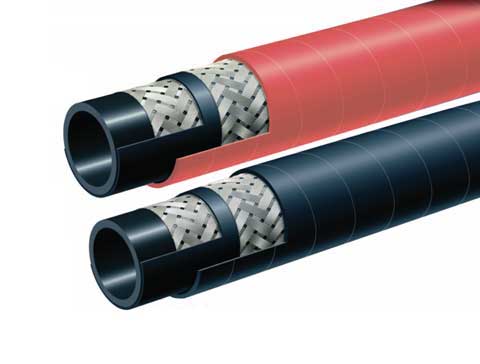
Double layer woven reinforced EPDM cooling hose with burst pressure exceeding 4 times the working pressure, safe and reliable
release date:2026-06-29 14:43:51
reading volume:
share:
In data center liquid cooling systems, AI computing power clusters, and new energy thermal management equipment, the pressure safety of cooling pipelines is the bottom line and red line of system design. The start stop of the cooling pump, the adjustment of the temperature control valve, and the flow fluctuations of multi node parallel liquid supply will all generate instantaneous pressure spikes in the pipeline. If the explosion safety margin of the hose is insufficient, an abnormal overpressure may lead to pipe leakage - coolant splashing onto precision electronic equipment, causing millions of equipment losses and long-term business interruptions. The double-layer woven reinforced EPDM cooling hose is a perfect example of "redundant design" for this safety requirement - it uses double-layer fiber weaving to construct a mechanical skeleton, providing ample safety margin with a burst margin of 4 times the working pressure, and EPDM weather resistant and temperature resistant material to ensure long-term reliability, becoming a reliable "safety redundancy defense line" in liquid cooling systems.
 1、 4 times safety factor: engineering logic from standard benchmark to redundant design
The threshold of '4 times the working pressure for blasting pressure' is not a common practice in the industry, but a key watershed for measuring the safety level of hoses. According to industry technical specifications, high-performance liquid cooled hoses generally follow this safety factor standard. Taking a liquid cooled hose with a working pressure of 300psi (approximately 2.07MPa) as an example, its small burst pressure should reach 1200psi (approximately 8.3MPa), which provides sufficient "buffer space" for transient overpressure of the system under abnormal operating conditions.
The engineering value of a 4-fold safety factor is reflected in three aspects: firstly, to deal with the water hammer effect at the moment of starting the cooling pump - the circulating pump of the liquid cooling system in the data center may generate an instantaneous pressure peak of 2-3 times the normal working pressure when starting, and the 4-fold margin ensures that this impact will not trigger hose failure. Secondly, compensating for the performance degradation of materials during long-term service - EPDM materials experience a gradual decrease in burst pressure after thermal oxidative aging and coolant immersion, with a 4-fold initial margin ensuring sufficient safety margin at the end of aging. Thirdly, it accommodates manufacturing tolerances and extreme environmental deviations - such as material performance fluctuations between batches and small distortions during installation, without touching the failure boundary under 4x redundancy.
From the actual product parameters, the LT800 series EPDM liquid cooled hose is set with a working pressure of 1.38MPa and a burst pressure of 5.5MPa (about 4 times) for 1/4 inch to 3/8 inch specifications, and a working pressure of 1.0MPa and a burst pressure of 4.0MPa (about 4 times) for 1/2 inch and above specifications. The CJFLEX HAT series liquid cooled hoses maintain a working pressure of 300psi and a burst pressure of 1200psi at four times the ratio. Dixon's EPDM liquid cooled hose is also designed with a working pressure of 16 bar and a safety factor of 3:1. These product parameters indicate that a 4-fold safety factor is a professional consensus for liquid cooling applications in data centers.
2、 Double layer weaving: How to construct a "mechanical skeleton" with 4 times the margin
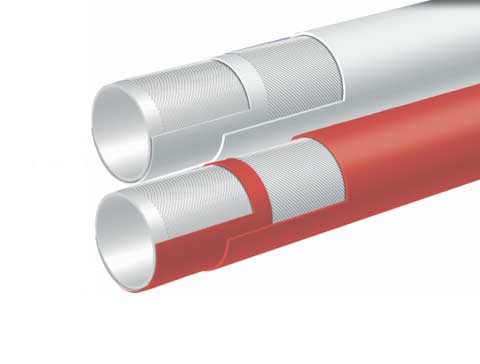
Realizing a blasting pressure four times the working pressure cannot be achieved simply by "thickening the pipe wall". The structural design of double-layer woven reinforcement layer is the mechanical guarantee of this safety margin.
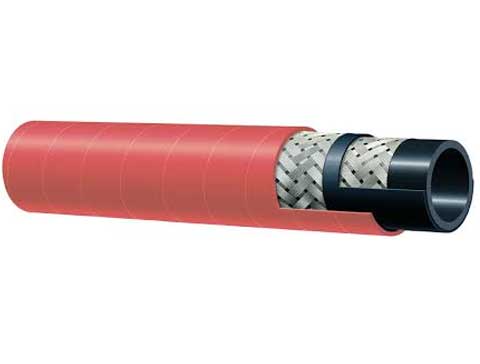
The layer is woven tightly against the inner adhesive layer, using high-strength polyester fibers woven at specific angles to form a basic compressive skeleton that bears the circumferential stress generated by internal pressure. The second layer of weaving covers the layer, intertwining at opposite angles to form a "cross interlocking" structure with the layer - the synergistic effect of the two layers of fiber weaving effectively restricts the radial expansion of the hose under internal pressure, suppresses axial elongation, and maintains overall dimensional stability of the hose.
Taking the LT800 series as an example, its reinforcement layer is clearly labeled as "one or two layers of synthetic fiber woven reinforcement". The key to this design lies in the precise control of weaving angle and density - if the weaving angle deviates from the "neutral angle" of 54 ° 44 ′, it may cause excessive elongation or radial expansion of the hose under pressure, affecting the sealing reliability of the joint; Insufficient weaving density cannot provide sufficient tensile strength. The double-layer woven structure reduces the load on a single layer of fibers significantly by sharing the stress between the two layers, thereby achieving thinner pipe walls and smaller bending radii under the same burst pressure.
The burst pressure test is the final level to verify a 4-fold safety factor. In the factory inspection, samples of each batch of hoses need to be taken for hydraulic burst testing - pressurized at a constant rate until the pipe body ruptures, and the measured burst pressure must be ≥ 4 times the working pressure. The measured data of CJFLEX HAT series shows that its burst pressure of 1200psi can be stably maintained, even after undergoing thermal aging or coolant immersion, it can still maintain this safety level.
3、 System Integration: Comprehensive Guarantee from Material Compatibility to Fire Safety
The safety advantage of double-layer weaving with 4 times the explosive margin is continuously demonstrated throughout the entire lifecycle of the liquid cooling system in data centers, thanks to the system synergy of EPDM material and flame retardant design.
The wide temperature range and chemical stability of EPDM provide a medium environment guarantee with a 4-fold margin. EPDM lining maintains chemical inertness to water, water ethylene glycol, and propylene glycol based antifreeze within the temperature range of -40 ℃ to+120 ℃, without swelling, hydrolysis, or precipitation. This means that even if the hose is operated in a high-temperature coolant environment for a long time, the mechanical properties of its inner adhesive layer will not significantly decrease due to medium erosion, thus ensuring that the 4-fold blasting allowance can still be maintained after several years of service. The PetroHose DCC150 series also uses peroxide vulcanized EPDM inner and outer layers, with a working temperature range of -40 ℃ to+100 ℃ and a burst pressure of 600psi.
The V0 level flame-retardant outer coating is an extended guarantee of safety redundancy. The data center security regulations require all polymer materials to quickly self extinguish upon contact with an open flame. The LT800 series and Dixon Dico Saint EPDM hoses have passed UL94 V0 flame retardant certification. When an external fire source accidentally ignites surrounding materials, the outer coating of the hose does not support combustion and does not produce ignition droplets, thus providing a "peripheral safety zone" for 4 times the blasting margin.
The matching and installation specifications of the joints also affect the realization of a 4-fold margin. Liquid cooled hoses are usually equipped with UQD (universal quick disconnect) fittings or clamp type fittings, and the crimping process of the fittings must ensure that the bonding strength with the reinforcement layer is not less than 85% of the burst strength of the pipe body. The bending radius during installation should not be less than the specified minimum value - taking the LT800 3/8 inch specification as an example, the small bending radius is only 37mm. If the fiber weaving layer is damaged due to excessive bending during installation, the actual burst pressure may be lower than the factory nominal value. Therefore, the on-site pipe laying must strictly follow the bending half diameter limit.
In summary, the double-layer braided reinforced EPDM cooling hose perfectly meets the strict requirements of data centers and new energy liquid cooling systems for "high safety redundancy" with its mechanical skeleton of double-layer fiber braiding, sufficient explosion margin of 4 times the working pressure, long-term stability of EPDM wide temperature range corrosion-resistant material, and safety barrier of V0 level flame retardant coating. From a working pressure of 1.38MPa to four times the explosive pressure of 5.5MPa, from a small bending radius of 37mm to UL94 V0 flame retardant certification, every technical detail points to the same goal: to provide zero explosion, zero leakage, and zero risk safety guarantees for liquid cooling systems next to electronic devices that operate continuously for 7 × 24 hours.
1、 4 times safety factor: engineering logic from standard benchmark to redundant design
The threshold of '4 times the working pressure for blasting pressure' is not a common practice in the industry, but a key watershed for measuring the safety level of hoses. According to industry technical specifications, high-performance liquid cooled hoses generally follow this safety factor standard. Taking a liquid cooled hose with a working pressure of 300psi (approximately 2.07MPa) as an example, its small burst pressure should reach 1200psi (approximately 8.3MPa), which provides sufficient "buffer space" for transient overpressure of the system under abnormal operating conditions.
The engineering value of a 4-fold safety factor is reflected in three aspects: firstly, to deal with the water hammer effect at the moment of starting the cooling pump - the circulating pump of the liquid cooling system in the data center may generate an instantaneous pressure peak of 2-3 times the normal working pressure when starting, and the 4-fold margin ensures that this impact will not trigger hose failure. Secondly, compensating for the performance degradation of materials during long-term service - EPDM materials experience a gradual decrease in burst pressure after thermal oxidative aging and coolant immersion, with a 4-fold initial margin ensuring sufficient safety margin at the end of aging. Thirdly, it accommodates manufacturing tolerances and extreme environmental deviations - such as material performance fluctuations between batches and small distortions during installation, without touching the failure boundary under 4x redundancy.
From the actual product parameters, the LT800 series EPDM liquid cooled hose is set with a working pressure of 1.38MPa and a burst pressure of 5.5MPa (about 4 times) for 1/4 inch to 3/8 inch specifications, and a working pressure of 1.0MPa and a burst pressure of 4.0MPa (about 4 times) for 1/2 inch and above specifications. The CJFLEX HAT series liquid cooled hoses maintain a working pressure of 300psi and a burst pressure of 1200psi at four times the ratio. Dixon's EPDM liquid cooled hose is also designed with a working pressure of 16 bar and a safety factor of 3:1. These product parameters indicate that a 4-fold safety factor is a professional consensus for liquid cooling applications in data centers.
2、 Double layer weaving: How to construct a "mechanical skeleton" with 4 times the margin
Realizing a blasting pressure four times the working pressure cannot be achieved simply by "thickening the pipe wall". The structural design of double-layer woven reinforcement layer is the mechanical guarantee of this safety margin.
The layer is woven tightly against the inner adhesive layer, using high-strength polyester fibers woven at specific angles to form a basic compressive skeleton that bears the circumferential stress generated by internal pressure. The second layer of weaving covers the layer, intertwining at opposite angles to form a "cross interlocking" structure with the layer - the synergistic effect of the two layers of fiber weaving effectively restricts the radial expansion of the hose under internal pressure, suppresses axial elongation, and maintains overall dimensional stability of the hose.
Taking the LT800 series as an example, its reinforcement layer is clearly labeled as "one or two layers of synthetic fiber woven reinforcement". The key to this design lies in the precise control of weaving angle and density - if the weaving angle deviates from the "neutral angle" of 54 ° 44 ′, it may cause excessive elongation or radial expansion of the hose under pressure, affecting the sealing reliability of the joint; Insufficient weaving density cannot provide sufficient tensile strength. The double-layer woven structure reduces the load on a single layer of fibers significantly by sharing the stress between the two layers, thereby achieving thinner pipe walls and smaller bending radii under the same burst pressure.
The burst pressure test is the final level to verify a 4-fold safety factor. In the factory inspection, samples of each batch of hoses need to be taken for hydraulic burst testing - pressurized at a constant rate until the pipe body ruptures, and the measured burst pressure must be ≥ 4 times the working pressure. The measured data of CJFLEX HAT series shows that its burst pressure of 1200psi can be stably maintained, even after undergoing thermal aging or coolant immersion, it can still maintain this safety level.
3、 System Integration: Comprehensive Guarantee from Material Compatibility to Fire Safety
The safety advantage of double-layer weaving with 4 times the explosive margin is continuously demonstrated throughout the entire lifecycle of the liquid cooling system in data centers, thanks to the system synergy of EPDM material and flame retardant design.
The wide temperature range and chemical stability of EPDM provide a medium environment guarantee with a 4-fold margin. EPDM lining maintains chemical inertness to water, water ethylene glycol, and propylene glycol based antifreeze within the temperature range of -40 ℃ to+120 ℃, without swelling, hydrolysis, or precipitation. This means that even if the hose is operated in a high-temperature coolant environment for a long time, the mechanical properties of its inner adhesive layer will not significantly decrease due to medium erosion, thus ensuring that the 4-fold blasting allowance can still be maintained after several years of service. The PetroHose DCC150 series also uses peroxide vulcanized EPDM inner and outer layers, with a working temperature range of -40 ℃ to+100 ℃ and a burst pressure of 600psi.
The V0 level flame-retardant outer coating is an extended guarantee of safety redundancy. The data center security regulations require all polymer materials to quickly self extinguish upon contact with an open flame. The LT800 series and Dixon Dico Saint EPDM hoses have passed UL94 V0 flame retardant certification. When an external fire source accidentally ignites surrounding materials, the outer coating of the hose does not support combustion and does not produce ignition droplets, thus providing a "peripheral safety zone" for 4 times the blasting margin.
The matching and installation specifications of the joints also affect the realization of a 4-fold margin. Liquid cooled hoses are usually equipped with UQD (universal quick disconnect) fittings or clamp type fittings, and the crimping process of the fittings must ensure that the bonding strength with the reinforcement layer is not less than 85% of the burst strength of the pipe body. The bending radius during installation should not be less than the specified minimum value - taking the LT800 3/8 inch specification as an example, the small bending radius is only 37mm. If the fiber weaving layer is damaged due to excessive bending during installation, the actual burst pressure may be lower than the factory nominal value. Therefore, the on-site pipe laying must strictly follow the bending half diameter limit.
In summary, the double-layer braided reinforced EPDM cooling hose perfectly meets the strict requirements of data centers and new energy liquid cooling systems for "high safety redundancy" with its mechanical skeleton of double-layer fiber braiding, sufficient explosion margin of 4 times the working pressure, long-term stability of EPDM wide temperature range corrosion-resistant material, and safety barrier of V0 level flame retardant coating. From a working pressure of 1.38MPa to four times the explosive pressure of 5.5MPa, from a small bending radius of 37mm to UL94 V0 flame retardant certification, every technical detail points to the same goal: to provide zero explosion, zero leakage, and zero risk safety guarantees for liquid cooling systems next to electronic devices that operate continuously for 7 × 24 hours.
Previous: