Highly Wear-Resistant UPE Hoses for Mine Tailings Slurry Transport
release date:2026-11-05 09:50:47
reading volume:
share:
In the entire process of mine tailings management, the long-distance transport of high-concentration tailings slurry consistently ranks as one of the most costly aspects of operation and maintenance. Such media contain not only a large volume of sharp, hard ore particles but often also corrosive acidic or alkaline components. When standard steel pipes or conventional rubber hoses are used, their inner walls rapidly suffer from wear-induced perforation or corrosion-related leakage. Frequent pipeline replacement not only drives up operational expenses but also poses a significant risk of environmental and safety incidents caused by tailings leakage. Specialized, highly wear-resistant UPE (Ultra-High Molecular Weight Polyethylene) hoses—engineered specifically for the extreme conditions of mine tailings transport—combine the exceptional wear resistance of UPE with a flexible, pressure-bearing structure. They serve as a key solution for significantly reducing long-term operational and maintenance costs in tailings transport applications.
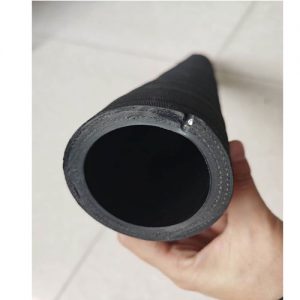 A specialized, thickened UPE inner liner provides resistance against high-speed cutting and abrasion from tailings particles.
The ore particles found in mine tailings slurry are characterized by high hardness and sharp edges; as they flow at high speeds, they exert intense cutting and erosive forces on the pipe walls. Under such continuous impact, the inner walls of standard pipelines are prone to rapid pitting and localized perforation. The core advantage of this hose lies in its thickened UPE (Ultra-High Molecular Weight Polyethylene) inner liner, which is purpose-built for tailings handling environments and addresses the root cause of particle-induced wear.
With a molecular weight reaching into the millions, the ultra-long molecular chain structure of UPE grants it impact and cut resistance far superior to that of conventional wear-resistant rubber or standard engineering plastics. In identical tailings transport conditions, its service life—in terms of wear resistance—is more than eight times that of standard wear-resistant rubber and five to ten times that of conventional steel piping. When high-concentration tailings slurry—laden with sharp ore particles—flows at high velocity against the pipe wall, the ultra-low surface friction coefficient of the UPE (Ultra-High Molecular Weight Polyethylene) liner significantly reduces the abrasive and cutting forces exerted by the particles. This prevents the rapid degradation typically seen when such particles strike or "cut" into conventional rubber or metal surfaces, fundamentally slowing the rate of wear. Unlike the thin UPE liners found in standard chemical-transfer hoses, the liner in this tailings-specific hose is intentionally thickened. This provides a substantial safety margin for long-term, high-load tailings transport, ensuring a stable service life of several years—even under the extreme erosive conditions posed by high-hardness metallic mine tailings—without the risk of localized "wear-through" failures.
Furthermore, UPE is inherently chemically inert. It remains unaffected by the acidic or alkaline corrosive components commonly present in mine tailings. Consequently, it avoids the accelerated wear caused by chemical corrosion—a frequent issue with steel pipes—as well as the swelling, degradation, and premature failure often experienced by standard rubber liners when exposed to corrosive substances over time. This delivers a dual advantage: exceptional wear resistance combined with superior corrosion resistance. The UPE liner also features an ultra-smooth surface, which prevents tailings particles from adhering to the pipe wall and forming scale. This ensures that the pipe’s internal cross-sectional area remains unobstructed, preventing issues such as increased pump pressure or reduced transport efficiency, and maintaining consistent, reliable tailings conveyance.
A reinforced, composite structure engineered for long-term, heavy-duty service in demanding field environments.
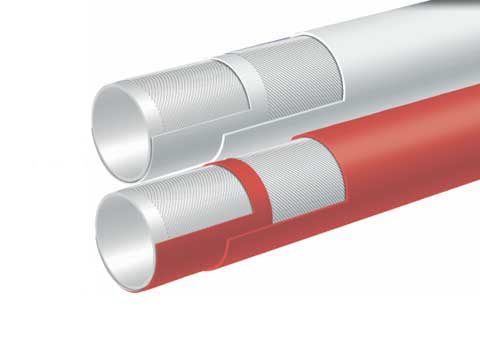
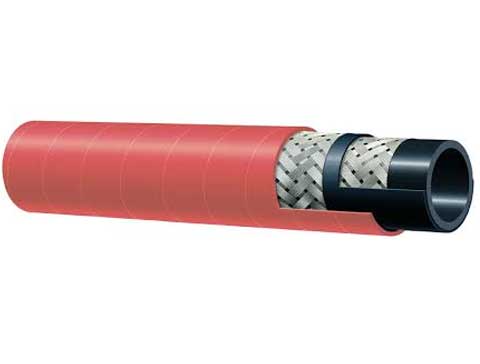
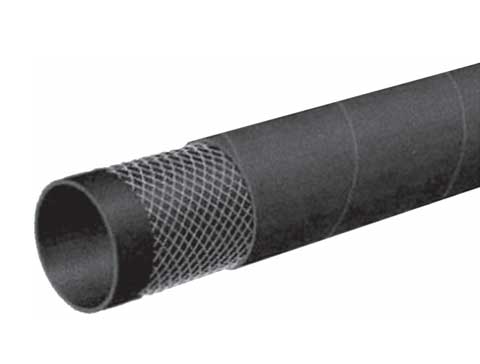
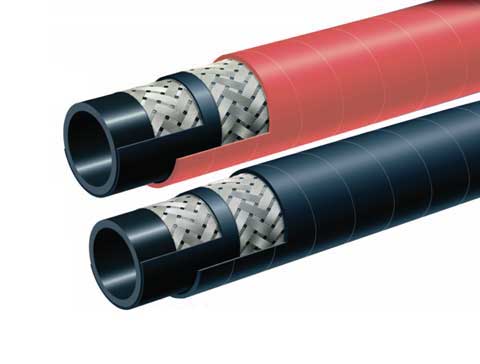
Tailings pipelines are frequently installed in open-air, field environments. They must endure not only the pressurized impact of high-concentration tailings slurry but also the stresses of being dragged across complex terrain, the tension caused by uneven ground settlement, and the repeated onslaught of extreme temperatures. The composite structure of this hose has been specifically reinforced for such rugged, outdoor mining conditions, offering environmental adaptability far superior to that of standard industrial hoses. On the exterior of the thickened UPE (Ultra-High Molecular Weight Polyethylene) liner, a specialized activated transition bonding layer ensures a fully integrated connection between the liner and the outer rubber reinforcement layer. This completely eliminates the risk of delamination or separation between the liner and the outer structure during long-term pressurized transport. The intermediate reinforcement layer features a composite framework—a multi-layered weave of high-strength flexible steel wire and synthetic fibers—specifically optimized for the pressure ranges encountered in tailings transport. This allows the hose to reliably withstand the rated operating pressures of tailings slurry pumps, preventing issues such as wall bulging or localized ruptures, even under the continuous, pulsating impact of high-flow, high-concentration tailings slurries. Furthermore, this flexible framework provides the hose with exceptional resistance to tension and deformation; in the event of uneven ground settlement, the hose can absorb tensile stress through its own flexible deformation, avoiding the catastrophic weld failures or pipe ruptures typical of rigid steel piping.
The outer cover is composed of a specialized, thickened, wear-resistant, and weather-resistant rubber designed specifically for mining applications. It withstands severe abrasion from rough, rocky terrain during field deployment—preventing the kind of wear-through by sharp stones that would compromise standard hoses—while also enduring long-term exposure to intense ultraviolet radiation and extreme temperature fluctuations in open-air environments, thereby preventing premature cracking, aging, or peeling. Additionally, the outer cover protects against corrosive mists (emanating from tailings) and rainwater, providing comprehensive shielding for the internal reinforcement framework and UPE liner. This prevents the reinforcement from becoming exposed and rusting—which would otherwise degrade the hose's overall mechanical integrity—ensuring that the hose maintains a stable structural condition over the long term, even in remote field environments without frequent manual maintenance. Quick-Connect Assembly: A Comprehensive Solution for Diverse Tailings Transport Scenarios
Tailings transport in mining operations often involves long distances and complex terrain. Traditional steel piping—which requires on-site welding—is not only inefficient but also complicates future maintenance and replacement. This highly wear-resistant UPE (Ultra-High Molecular Weight Polyethylene) hose features a standardized, quick-connect assembly specifically designed for mining environments. It effectively addresses the pain points associated with the installation and maintenance of tailings pipelines, meeting the requirements of a wide range of transport scenarios.
The accompanying couplings are crafted from high-strength alloy and treated with comprehensive anti-corrosion coatings, making them perfectly suited for the harsh, corrosive conditions of mining sites. Utilizing a high-precision CNC swaging process, the coupling’s internal interlocking structure creates a rigid, integrated bond with the hose’s internal steel-wire reinforcement. This eliminates the risk of the hose detaching from the coupling under the high-pressure conditions typical of tailings transport. Furthermore, the sealing system has been specifically optimized for tailings media; it employs wear-resistant, specialized seals that withstand abrasion from tailings particles, preventing leaks and ensuring that pressurized tailings slurry cannot spray out at connection points. The standardized coupling specifications allow for seamless, rapid integration with existing on-site steel pipes, flanges, and union connections—eliminating the need for custom adapters. Because no welding is required, the pipeline can be assembled manually and rapidly, boosting installation efficiency by more than five times compared to traditional steel piping and significantly shortening the construction timeline for tailings transport lines.
In practical mining applications, this hose is adaptable to a variety of complex operating conditions: for long-distance main tailings lines, its flexible structure allows it to follow the natural contours of the terrain, removing the need for extensive rigid elbows or complex foundation preparation. For mobile discharge lines at tailings storage facilities, the hose can be easily dragged and repositioned—a task that would otherwise demand significant labor and resources if using steel pipes. Additionally, when used as a flexible connector between tailings pump stations and main pipelines, the hose effectively absorbs high-frequency vibrations generated by the pumps, preventing the frequent weld cracking often caused by rigid connections. For mining enterprises, adopting these specialized UPE (Ultra-High Molecular Weight Polyethylene) hoses for tailings transport offers significant advantages. Beyond extending service life—thereby reducing long-term procurement and maintenance costs—these hoses help prevent environmental incidents caused by sudden wear-related leaks, while also minimizing production losses from unplanned downtime. During routine operations, simply monitoring the wear on the outer layer and the integrity of the seals at connection points allows for accurate estimation of the remaining service life. This enables proactive replacement planning, effectively eliminating the risk of unexpected leaks.
As the mining industry places an increasing emphasis on green and safe production, these highly reliable, low-maintenance tailings transport hoses are progressively replacing traditional steel pipes. They have become the preferred solution for tailings conveyance, establishing a flexible, highly wear-resistant, and leak-proof safety barrier for long-distance tailings transport in mining operations.
Previous: