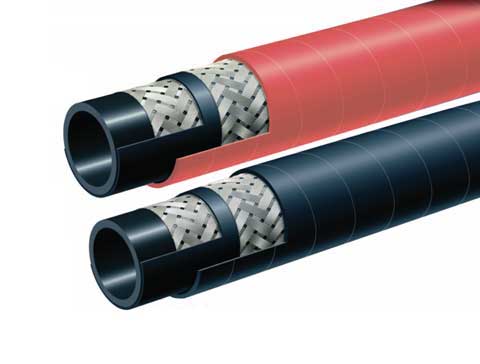
Oil-resistant and corrosion-resistant hydraulic hose, with nitrile rubber inner rubber, suitable for mineral oil medium
release date:2026-05-07 10:48:25
reading volume:
share:
In hydraulic transmission systems, hydraulic hoses serve as crucial flexible components connecting pumps, valves, and actuators. The medium compatibility of their inner rubber layer directly determines the reliability and service life of the entire pipeline system. Mineral oil-based hydraulic oil is currently a widely used hydraulic medium in the industrial and construction machinery fields, and nitrile rubber (NBR), with its unique molecular structure, has become an inherently compatible inner rubber material with mineral oil. This article analyzes the technical advantages of nitrile rubber inner hydraulic hoses in mineral oil medium from three dimensions: material characteristics, structural design, and application selection.
 1. Molecular Code: The Chemical Basis of Nitrile Rubber's Resistance to Mineral Oil
The reason why nitrile rubber has become the material for the inner rubber layer of hydraulic hoses lies in the polar nitrile (-CN) structure in its molecular chain. This functional group endows nitrile rubber with a natural resistance to non-polar mineral oil - when mineral oil comes into contact with nitrile rubber, oil molecules find it difficult to penetrate between the rubber molecular chains, thus effectively inhibiting the swelling and softening of the material.
Based on the study on the compatibility of seals with lubricating oils, nitrile rubber exhibits excellent resistance to petroleum-based media such as mineral-based lubricating oils, hydraulic oils, fuel oils, and gasoline, with volume change rates controlled to a very low range. In the ASTM D471 standard test, high-quality nitrile rubber, after being immersed in mineral oil for 1000 hours, shows a volume expansion rate of less than 3% and a hardness change of no more than 5 Shore A. This characteristic ensures that the inner rubber layer of the hose maintains stable sealing performance and dimensional accuracy throughout long-term service.
Modern nitrile rubber technology has evolved from ordinary NBR to carboxyl-modified nitrile rubber. By introducing carboxyl functional groups, the oil resistance, wear resistance, and anti-aging capabilities of the material are further enhanced. Taking Eneos carboxyl-modified NBR N641 as an example, its oil resistance volume change rate in mineral oil can be controlled within 10%, its tensile strength reaches 20-30MPa, and its elongation at break is 500-700%. Its comprehensive performance is improved by more than 50% compared to ordinary NBR. The successful development of domestic high-resilience special nitrile rubber NBR3306G has broken the foreign monopoly on nitrile rubber for high-pressure oil-resistant hoses. The Mooney viscosity fluctuation is controlled within a narrow distribution range of ±3, and the bound acrylonitrile is controlled within ±1%, meeting the stringent requirements of construction machinery for more than 400,000 pulse tests.
II. Structural Synergy: A Three-Layer Composite Oil-Resistant Protection System
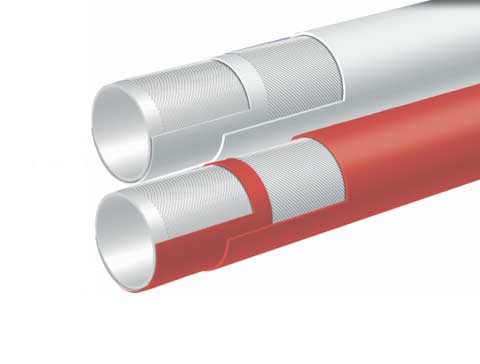
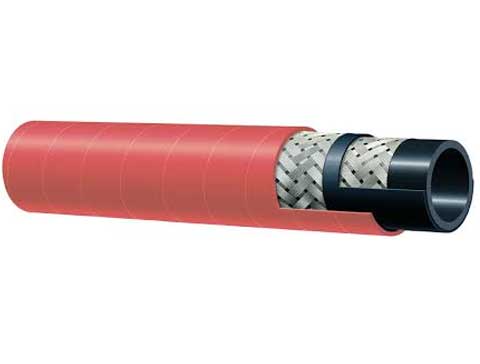
The excellent performance of oil-resistant and corrosion-resistant hydraulic hoses not only relies on the material selection of the inner rubber layer, but also stems from the systematic integration of the three-layer structure of the inner rubber layer, reinforcement layer, and outer rubber layer.
The inner rubber layer serves as a chemical barrier that directly contacts mineral oil and is formulated with nitrile rubber with a high acrylonitrile content. The higher the acrylonitrile content, the stronger the oil resistance, but it also affects the low-temperature elasticity. Professional hose designs strike a balance within the acrylonitrile content range of 35%-40% - they can withstand long-term erosion from mineral oil media while maintaining flexibility across a wide temperature range from -30℃ to +100℃. Some high-end products also adopt a multi-layer early warning inner lining design, with an inner layer of high wear-resistant working layer and an outer layer of colored early warning layer. When the inner layer wears down to the warning line, the color change provides an intuitive indication of the need for replacement, avoiding medium leakage caused by wear through of the inner wall.
The reinforcement layer serves as the core skeleton for the hose to withstand high-pressure pulses. For hydraulic systems involving mineral oil media, the reinforcement layer commonly employs a single or double layer of high-strength steel wire braiding structure. Taking the DN25 specification as an example, the double-layer steel wire braiding structure can achieve a working pressure of 15-25 MPa, a burst pressure of 60-100 MPa (four times the working pressure), and a pulse life exceeding 200,000 cycles (as per ISO 6803 standard). The steel wire surface undergoes copper plating or phosphating treatment, which not only enhances the adhesion with rubber but also improves the corrosion resistance in a mineral oil environment. For higher pressure requirements, a four-layer or six-layer steel wire winding structure can be selected, achieving a working pressure of over 70 MPa.
The outer rubber layer serves as the first line of defense against external environmental erosion, typically utilizing chloroprene rubber (CR) or hydrogenated nitrile rubber (HNBR) as the base material. Chloroprene rubber exhibits excellent weather resistance, ozone resistance, and flame retardant properties, effectively preventing the spread of fire in the event of mineral oil leakage. Some specialized hoses for mines also incorporate flame retardant and antistatic agents, with surface resistance values controlled within 10⁶Ω, effectively preventing safety hazards caused by static electricity in coal mines. According to the DIN 53516 wear resistance test, the optimized formula can achieve a mass loss of as low as 0.5g per 5000 rubs, with a wear resistance index of 120mm³, representing a threefold increase in service life compared to conventional hoses.
III. Application adaptation: key points for selection and maintenance of mineral oil medium
Nitrile rubber inner hydraulic hoses are widely used in various hydraulic systems that utilize mineral oil as the medium. From excavators and loaders in construction machinery, to hydraulic supports in mining equipment, and further to injection molding machines and forging presses in industrial production, these hoses have become a standard configuration for hydraulic pipelines due to their excellent oil resistance.
The key points of selection need to comprehensively consider the system operating pressure, temperature range, and medium characteristics. The hose pressure rating should be selected based on 1.5 times the system pressure; the temperature range should ensure that the hose can be used within the range of -30℃ to +100℃, and special formulations should be used outside this range. In terms of medium, nitrile rubber has good compatibility with mineral-based hydraulic oil, 46# anti-wear hydraulic oil, fuel, and lubricating oil, but it has poor compatibility with water-based media such as phosphate ester synthetic oil and water glycol, and it is necessary to replace it with EPDM or FKM inner rubber.
Connector matching is crucial for harnessing the oil-resistant properties of hoses. Nitrile rubber inner-tube hoses are typically compatible with 24° cone seal connectors or flange connectors, forming a seamless connection between metal and rubber through a precise crimping process. During the crimping process, the connector core rod is embedded into the inner rubber layer to form the main seal, while the outer sleeve mechanically locks with the steel wire reinforcement layer. For MT98 mining hoses, the connectors adopt a 24° cone seal design combined with cold extrusion crimping technology, ensuring zero leakage even under severe vibration conditions.
Maintenance and lifespan management are equally noteworthy. In mineral oil media, a standard nitrile rubber inner hose can have a conventional service life of up to 5-7 years or more than 5,000 working hours. During routine inspections, it is important to focus on whether there are bulges or wear on the outer rubber layer, exposed steel wires, signs of leakage at the joints, and signs of hardening or embrittlement of the hose. After transporting mineral oil, if the system is shut down for a long period, it is recommended to drain the pipeline to prevent chronic erosion of the inner rubber layer caused by oil oxidation. When the outer diameter change rate exceeds 5% or the surface crack index exceeds the standard, it should be replaced in a timely manner.
In summary, the nitrile rubber inner hydraulic hose, with its oil-resistant molecular structure featuring polar nitrile groups, three-layer composite system protection, and stable performance across a wide temperature range, has become an ideal choice for hydraulic transmission in mineral oil media. From the technological upgrade from ordinary NBR to carboxyl-modified nitrile rubber, from the structural evolution from single-layer braiding to multi-layer winding, and from conventional working conditions to rigorous verification of flame retardancy for mining applications, every technical detail points to the same goal: to provide a 100% reliable oil-resistant power transmission channel for hydraulic systems amidst the roar of construction machinery and under the heavy-load conditions of mining equipment. As hydraulic systems develop towards high pressure and intelligence, the technological iteration of nitrile rubber inner hoses will continue to advance, providing a solid guarantee for the efficient operation of industrial equipment.
1. Molecular Code: The Chemical Basis of Nitrile Rubber's Resistance to Mineral Oil
The reason why nitrile rubber has become the material for the inner rubber layer of hydraulic hoses lies in the polar nitrile (-CN) structure in its molecular chain. This functional group endows nitrile rubber with a natural resistance to non-polar mineral oil - when mineral oil comes into contact with nitrile rubber, oil molecules find it difficult to penetrate between the rubber molecular chains, thus effectively inhibiting the swelling and softening of the material.
Based on the study on the compatibility of seals with lubricating oils, nitrile rubber exhibits excellent resistance to petroleum-based media such as mineral-based lubricating oils, hydraulic oils, fuel oils, and gasoline, with volume change rates controlled to a very low range. In the ASTM D471 standard test, high-quality nitrile rubber, after being immersed in mineral oil for 1000 hours, shows a volume expansion rate of less than 3% and a hardness change of no more than 5 Shore A. This characteristic ensures that the inner rubber layer of the hose maintains stable sealing performance and dimensional accuracy throughout long-term service.
Modern nitrile rubber technology has evolved from ordinary NBR to carboxyl-modified nitrile rubber. By introducing carboxyl functional groups, the oil resistance, wear resistance, and anti-aging capabilities of the material are further enhanced. Taking Eneos carboxyl-modified NBR N641 as an example, its oil resistance volume change rate in mineral oil can be controlled within 10%, its tensile strength reaches 20-30MPa, and its elongation at break is 500-700%. Its comprehensive performance is improved by more than 50% compared to ordinary NBR. The successful development of domestic high-resilience special nitrile rubber NBR3306G has broken the foreign monopoly on nitrile rubber for high-pressure oil-resistant hoses. The Mooney viscosity fluctuation is controlled within a narrow distribution range of ±3, and the bound acrylonitrile is controlled within ±1%, meeting the stringent requirements of construction machinery for more than 400,000 pulse tests.
II. Structural Synergy: A Three-Layer Composite Oil-Resistant Protection System
The excellent performance of oil-resistant and corrosion-resistant hydraulic hoses not only relies on the material selection of the inner rubber layer, but also stems from the systematic integration of the three-layer structure of the inner rubber layer, reinforcement layer, and outer rubber layer.
The inner rubber layer serves as a chemical barrier that directly contacts mineral oil and is formulated with nitrile rubber with a high acrylonitrile content. The higher the acrylonitrile content, the stronger the oil resistance, but it also affects the low-temperature elasticity. Professional hose designs strike a balance within the acrylonitrile content range of 35%-40% - they can withstand long-term erosion from mineral oil media while maintaining flexibility across a wide temperature range from -30℃ to +100℃. Some high-end products also adopt a multi-layer early warning inner lining design, with an inner layer of high wear-resistant working layer and an outer layer of colored early warning layer. When the inner layer wears down to the warning line, the color change provides an intuitive indication of the need for replacement, avoiding medium leakage caused by wear through of the inner wall.
The reinforcement layer serves as the core skeleton for the hose to withstand high-pressure pulses. For hydraulic systems involving mineral oil media, the reinforcement layer commonly employs a single or double layer of high-strength steel wire braiding structure. Taking the DN25 specification as an example, the double-layer steel wire braiding structure can achieve a working pressure of 15-25 MPa, a burst pressure of 60-100 MPa (four times the working pressure), and a pulse life exceeding 200,000 cycles (as per ISO 6803 standard). The steel wire surface undergoes copper plating or phosphating treatment, which not only enhances the adhesion with rubber but also improves the corrosion resistance in a mineral oil environment. For higher pressure requirements, a four-layer or six-layer steel wire winding structure can be selected, achieving a working pressure of over 70 MPa.
The outer rubber layer serves as the first line of defense against external environmental erosion, typically utilizing chloroprene rubber (CR) or hydrogenated nitrile rubber (HNBR) as the base material. Chloroprene rubber exhibits excellent weather resistance, ozone resistance, and flame retardant properties, effectively preventing the spread of fire in the event of mineral oil leakage. Some specialized hoses for mines also incorporate flame retardant and antistatic agents, with surface resistance values controlled within 10⁶Ω, effectively preventing safety hazards caused by static electricity in coal mines. According to the DIN 53516 wear resistance test, the optimized formula can achieve a mass loss of as low as 0.5g per 5000 rubs, with a wear resistance index of 120mm³, representing a threefold increase in service life compared to conventional hoses.
III. Application adaptation: key points for selection and maintenance of mineral oil medium
Nitrile rubber inner hydraulic hoses are widely used in various hydraulic systems that utilize mineral oil as the medium. From excavators and loaders in construction machinery, to hydraulic supports in mining equipment, and further to injection molding machines and forging presses in industrial production, these hoses have become a standard configuration for hydraulic pipelines due to their excellent oil resistance.
The key points of selection need to comprehensively consider the system operating pressure, temperature range, and medium characteristics. The hose pressure rating should be selected based on 1.5 times the system pressure; the temperature range should ensure that the hose can be used within the range of -30℃ to +100℃, and special formulations should be used outside this range. In terms of medium, nitrile rubber has good compatibility with mineral-based hydraulic oil, 46# anti-wear hydraulic oil, fuel, and lubricating oil, but it has poor compatibility with water-based media such as phosphate ester synthetic oil and water glycol, and it is necessary to replace it with EPDM or FKM inner rubber.
Connector matching is crucial for harnessing the oil-resistant properties of hoses. Nitrile rubber inner-tube hoses are typically compatible with 24° cone seal connectors or flange connectors, forming a seamless connection between metal and rubber through a precise crimping process. During the crimping process, the connector core rod is embedded into the inner rubber layer to form the main seal, while the outer sleeve mechanically locks with the steel wire reinforcement layer. For MT98 mining hoses, the connectors adopt a 24° cone seal design combined with cold extrusion crimping technology, ensuring zero leakage even under severe vibration conditions.
Maintenance and lifespan management are equally noteworthy. In mineral oil media, a standard nitrile rubber inner hose can have a conventional service life of up to 5-7 years or more than 5,000 working hours. During routine inspections, it is important to focus on whether there are bulges or wear on the outer rubber layer, exposed steel wires, signs of leakage at the joints, and signs of hardening or embrittlement of the hose. After transporting mineral oil, if the system is shut down for a long period, it is recommended to drain the pipeline to prevent chronic erosion of the inner rubber layer caused by oil oxidation. When the outer diameter change rate exceeds 5% or the surface crack index exceeds the standard, it should be replaced in a timely manner.
In summary, the nitrile rubber inner hydraulic hose, with its oil-resistant molecular structure featuring polar nitrile groups, three-layer composite system protection, and stable performance across a wide temperature range, has become an ideal choice for hydraulic transmission in mineral oil media. From the technological upgrade from ordinary NBR to carboxyl-modified nitrile rubber, from the structural evolution from single-layer braiding to multi-layer winding, and from conventional working conditions to rigorous verification of flame retardancy for mining applications, every technical detail points to the same goal: to provide a 100% reliable oil-resistant power transmission channel for hydraulic systems amidst the roar of construction machinery and under the heavy-load conditions of mining equipment. As hydraulic systems develop towards high pressure and intelligence, the technological iteration of nitrile rubber inner hoses will continue to advance, providing a solid guarantee for the efficient operation of industrial equipment.