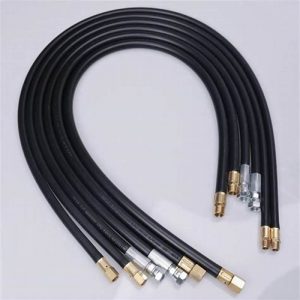
Integrated flange connector hydraulic hose assembly, leak-proof, ready to use
release date:2026-05-07 10:46:23
reading volume:
share:
In the pipeline connection of hydraulic systems, flange connectors are key components that bear high pressure and ensure sealing. Traditional split flanges require on-site assembly of multiple parts such as flange clamps, bolts, and sealing rings, which is cumbersome and prone to leakage hazards due to improper operation. The advent of the integrated flange connector hydraulic hose assembly has completely changed this situation - it integrates the flange clamp and the connector body into one unit, and has undergone precise crimping and sealing tests before leaving the factory. On-site installation can be completed by simply tightening the bolts, fulfilling the promises of "ready to use" and "zero leakage".
 1. Integrated structure: The revolution from "multiple pieces assembly" to "single piece integration"
Traditional flange connections require multiple independent parts such as split flange clamps (FCS/FCSM), sealing rings, and fastening bolts, which need to be assembled one by one during on-site installation. This process is not only time-consuming but also prone to leakage if any of the parts are installed incorrectly. Integrated flange connectors, on the other hand, integrate these functions into a single component - the flange body and connector core rod are forged integrally, with the flange clamp and sealing structure pre-assembled in place. On-site installation simply involves aligning the bolt holes and tightening them.
In the national standard GB/T 42086.2-2022 "Hydraulic Fluid Power Connections - Flanged Connections - Part 2: 42 MPa, DN13 to DN76 Series", a clear distinction is made between two types of products: split flange clamps (FCS and FCSM) and integral flange clamps (FC and FCM). The integral flange clamps FC (Flange Clamp) and FCM (Flange Clamp Metric) integrate two half-clamps into a single structure, eliminating issues such as alignment errors and uneven bolt tightening during split assembly, and significantly improving connection reliability and installation efficiency.
Taking the SAE J518 standard as an example, the integrated flange adapters cover pressure ratings from 3000psi to 6000psi. The 3000psi series (such as 87311Y/87312Y) is suitable for conventional high-pressure systems, while the 6000psi series (such as 87611Y/87612Y) is designed for ultra-high pressure conditions. The flange body is made of high-strength carbon steel or stainless steel, with precision machining to ensure the flatness of the sealing surface, and surface galvanizing to enhance corrosion resistance. It is fully compatible with SAE J518 No. 61 and No. 62 flanges, allowing for seamless replacement of existing split-type solutions.
II. Leakage prevention design: dual safeguards of precise sealing and crimping
The "leak-proof" commitment of the integrated flange joint hydraulic hose assembly stems from the dual guarantees of the joint body sealing design and the assembly crimping process.
Precision machining of the sealing surface is the first line of defense against leakage. The sealing surface of the integrated flange joint undergoes precision turning to ensure that the surface roughness and flatness meet the design standards. Coupled with an O-ring seal (usually made of nitrile or fluororubber), it forms an initial sealing pressure. When high-pressure fluid enters, the medium pressure further acts on the sealing ring, achieving a "self-tightening" sealing effect - the higher the pressure, the tighter the sealing effect.
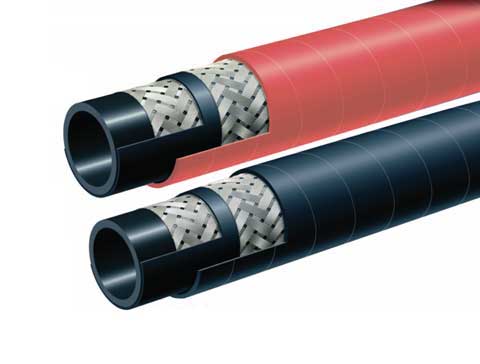
The crimping of hoses and connectors serves as the second line of defense against leaks. The integrated flange assembly completes the crimping connection between the hose and the connector during the production stage. The CNC crimping equipment precisely controls the crimping amount to within ±0.01mm, ensuring a tight fit between the connector core rod and the inner rubber of the tube, forming the main seal. Meanwhile, the outer sleeve mechanically locks with the reinforcement layer steel wire. This type of permanent connection completely eliminates the risk of leaks caused by improper crimping or insufficient fastening during on-site assembly.
The advanced integrated flange products also adopt a dual sealing ring structure. According to industry application data, the dual sealing ring structure can increase the sealing pressure from 0.82 MPa to 0.97 MPa, with an increase of 18%. The annual helium leak detection leakage is less than 0.01 milliliters, reaching the industry-leading level. This design is particularly suitable for highly sensitive scenarios such as marine engineering and petrochemical industry, where strict leakage restrictions are imposed.
III. Install and Use Immediately: From Installation Efficiency to Value Realization in the Whole Life Cycle
The core value of the integrated flange connector hydraulic hose assembly lies in the efficiency improvement and cost savings brought by its "ready-to-use" feature.
The leapfrog improvement in installation efficiency is an intuitive benefit. Traditional split flange installation on-site requires multiple steps such as assembling flange clamps, placing sealing rings, inserting bolts, and tightening according to torque, typically taking 10-15 minutes. After adopting the integrated flange assembly, on-site installation only requires aligning the joint with the oil port, inserting bolts, and tightening according to torque. The single connection time can be shortened to less than 30 seconds, which is more than 60 times more efficient than the traditional method. This is of great value in time-sensitive scenarios such as equipment maintenance and emergency repairs.
Modularity and maintainability are the extended advantages of ready-to-use products. Modern integrated flange products adopt a modular design concept - breaking down traditional integrated pipe fittings into three independent units: elbow, installation head, and connecting pipe. This not only enhances flexibility and maintainability but also allows for more than 5,000 repeated disassembly and assembly cycles without affecting sealing performance. This means that even if the equipment requires frequent disassembly and maintenance, the integrated flange assembly can still maintain long-term reliable sealing effect.
The optimization of total life cycle cost is the ultimate benefit manifestation. The integrated flange assembly has been fully assembled and tested before leaving the factory, eliminating the need for on-site crimping and inspection, thereby reducing the risk of on-site operational errors. When equipment requires maintenance, maintenance time can be shortened from 2 hours to 30 minutes, and the cost of spare parts replacement is reduced by 45%. For large hydraulic systems, the comprehensive benefits brought by reducing downtime and maintenance frequency far outweigh the procurement cost of the connectors themselves.
Standardization and compatibility ensure the widespread application of ready-to-use products. The integrated flange adapters comply with international standards such as SAE J518, ISO 6162, and DIN 20066, and are fully compatible with mainstream flange ports on the market. Meanwhile, the GB/T 42086 series of national standards covers the pressure range of flange connections from 3.5 MPa to 42 MPa and the diameter range from DN13 to DN127, providing a complete standardized solution for different pressure levels and application scenarios.
In summary, the integrated flange hydraulic hose assembly, with its three core technologies of integrated structure, precision sealing design, and secure crimping connection, perfectly embodies the product promise of "leak-proof, ready-to-use". From pressure coverage ranging from SAE 3000psi to 6000psi, to wide temperature adaptability from -40℃ to +120℃, and reliability verification from 30-second installation to 5000 repeated disassembly and assembly, every technical detail points to the same goal: providing a safe, efficient, and reliable pipeline connection solution for hydraulic systems. As the equipment manufacturing industry evolves towards efficiency and intelligence, the technical value of the integrated flange hose assembly will continue to be highlighted, becoming the upgraded choice for hydraulic pipeline connections.
1. Integrated structure: The revolution from "multiple pieces assembly" to "single piece integration"
Traditional flange connections require multiple independent parts such as split flange clamps (FCS/FCSM), sealing rings, and fastening bolts, which need to be assembled one by one during on-site installation. This process is not only time-consuming but also prone to leakage if any of the parts are installed incorrectly. Integrated flange connectors, on the other hand, integrate these functions into a single component - the flange body and connector core rod are forged integrally, with the flange clamp and sealing structure pre-assembled in place. On-site installation simply involves aligning the bolt holes and tightening them.
In the national standard GB/T 42086.2-2022 "Hydraulic Fluid Power Connections - Flanged Connections - Part 2: 42 MPa, DN13 to DN76 Series", a clear distinction is made between two types of products: split flange clamps (FCS and FCSM) and integral flange clamps (FC and FCM). The integral flange clamps FC (Flange Clamp) and FCM (Flange Clamp Metric) integrate two half-clamps into a single structure, eliminating issues such as alignment errors and uneven bolt tightening during split assembly, and significantly improving connection reliability and installation efficiency.
Taking the SAE J518 standard as an example, the integrated flange adapters cover pressure ratings from 3000psi to 6000psi. The 3000psi series (such as 87311Y/87312Y) is suitable for conventional high-pressure systems, while the 6000psi series (such as 87611Y/87612Y) is designed for ultra-high pressure conditions. The flange body is made of high-strength carbon steel or stainless steel, with precision machining to ensure the flatness of the sealing surface, and surface galvanizing to enhance corrosion resistance. It is fully compatible with SAE J518 No. 61 and No. 62 flanges, allowing for seamless replacement of existing split-type solutions.
II. Leakage prevention design: dual safeguards of precise sealing and crimping
The "leak-proof" commitment of the integrated flange joint hydraulic hose assembly stems from the dual guarantees of the joint body sealing design and the assembly crimping process.
Precision machining of the sealing surface is the first line of defense against leakage. The sealing surface of the integrated flange joint undergoes precision turning to ensure that the surface roughness and flatness meet the design standards. Coupled with an O-ring seal (usually made of nitrile or fluororubber), it forms an initial sealing pressure. When high-pressure fluid enters, the medium pressure further acts on the sealing ring, achieving a "self-tightening" sealing effect - the higher the pressure, the tighter the sealing effect.
The crimping of hoses and connectors serves as the second line of defense against leaks. The integrated flange assembly completes the crimping connection between the hose and the connector during the production stage. The CNC crimping equipment precisely controls the crimping amount to within ±0.01mm, ensuring a tight fit between the connector core rod and the inner rubber of the tube, forming the main seal. Meanwhile, the outer sleeve mechanically locks with the reinforcement layer steel wire. This type of permanent connection completely eliminates the risk of leaks caused by improper crimping or insufficient fastening during on-site assembly.
The advanced integrated flange products also adopt a dual sealing ring structure. According to industry application data, the dual sealing ring structure can increase the sealing pressure from 0.82 MPa to 0.97 MPa, with an increase of 18%. The annual helium leak detection leakage is less than 0.01 milliliters, reaching the industry-leading level. This design is particularly suitable for highly sensitive scenarios such as marine engineering and petrochemical industry, where strict leakage restrictions are imposed.
III. Install and Use Immediately: From Installation Efficiency to Value Realization in the Whole Life Cycle
The core value of the integrated flange connector hydraulic hose assembly lies in the efficiency improvement and cost savings brought by its "ready-to-use" feature.
The leapfrog improvement in installation efficiency is an intuitive benefit. Traditional split flange installation on-site requires multiple steps such as assembling flange clamps, placing sealing rings, inserting bolts, and tightening according to torque, typically taking 10-15 minutes. After adopting the integrated flange assembly, on-site installation only requires aligning the joint with the oil port, inserting bolts, and tightening according to torque. The single connection time can be shortened to less than 30 seconds, which is more than 60 times more efficient than the traditional method. This is of great value in time-sensitive scenarios such as equipment maintenance and emergency repairs.
Modularity and maintainability are the extended advantages of ready-to-use products. Modern integrated flange products adopt a modular design concept - breaking down traditional integrated pipe fittings into three independent units: elbow, installation head, and connecting pipe. This not only enhances flexibility and maintainability but also allows for more than 5,000 repeated disassembly and assembly cycles without affecting sealing performance. This means that even if the equipment requires frequent disassembly and maintenance, the integrated flange assembly can still maintain long-term reliable sealing effect.
The optimization of total life cycle cost is the ultimate benefit manifestation. The integrated flange assembly has been fully assembled and tested before leaving the factory, eliminating the need for on-site crimping and inspection, thereby reducing the risk of on-site operational errors. When equipment requires maintenance, maintenance time can be shortened from 2 hours to 30 minutes, and the cost of spare parts replacement is reduced by 45%. For large hydraulic systems, the comprehensive benefits brought by reducing downtime and maintenance frequency far outweigh the procurement cost of the connectors themselves.
Standardization and compatibility ensure the widespread application of ready-to-use products. The integrated flange adapters comply with international standards such as SAE J518, ISO 6162, and DIN 20066, and are fully compatible with mainstream flange ports on the market. Meanwhile, the GB/T 42086 series of national standards covers the pressure range of flange connections from 3.5 MPa to 42 MPa and the diameter range from DN13 to DN127, providing a complete standardized solution for different pressure levels and application scenarios.
In summary, the integrated flange hydraulic hose assembly, with its three core technologies of integrated structure, precision sealing design, and secure crimping connection, perfectly embodies the product promise of "leak-proof, ready-to-use". From pressure coverage ranging from SAE 3000psi to 6000psi, to wide temperature adaptability from -40℃ to +120℃, and reliability verification from 30-second installation to 5000 repeated disassembly and assembly, every technical detail points to the same goal: providing a safe, efficient, and reliable pipeline connection solution for hydraulic systems. As the equipment manufacturing industry evolves towards efficiency and intelligence, the technical value of the integrated flange hose assembly will continue to be highlighted, becoming the upgraded choice for hydraulic pipeline connections.
Previous: