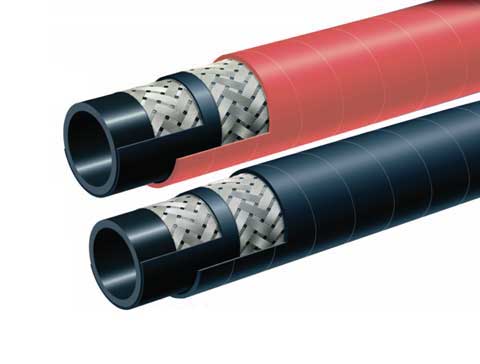
Three-ply fabric-reinforced EPDM rubber hose, rated for 10 bar pressure
release date:2026-11-12 10:18:46
reading volume:
share:
In applications such as industrial circulating water transport, municipal outdoor piping networks, and fluid circuits for general equipment—all of which involve low-to-medium pressure fluid conveyance—traditional fabric-reinforced rubber hoses often suffer from unstable pressure resistance and inadequate resistance to corrosion and weathering. Over time, these hoses are prone to delamination and sudden bursts, leading not only to fluid leakage but also to significant maintenance costs and operational downtime. Our three-layer fabric-reinforced EPDM rubber hose, designed for a 10-bar rated working pressure, leverages the inherent advantages of EPDM (ethylene propylene diene monomer) rubber. Through a precision-engineered three-layer fabric reinforcement structure, it ensures long-term, stable operation at 10 bar while offering exceptional resistance to acids, alkalis, weathering, and aging. This provides a highly reliable and cost-effective piping solution for general low-to-medium pressure fluid transport.
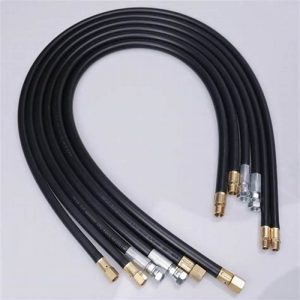 An all-EPDM rubber system: superior fluid compatibility and weather resistance
Many conventional three-layer fabric-reinforced water hoses utilize natural rubber or styrene-butadiene rubber (SBR). These materials are only suitable for the short-term transport of plain, clean water; when exposed to weak acids or alkalis, or subjected to long-term outdoor conditions, they quickly suffer from internal swelling and degradation, as well as rapid surface chalking and cracking—making them incapable of supporting long-term, continuous operation in complex working environments. In contrast, this 10-bar rated hose—from its inner liner and intermediate transition layer to its outer protective layer—is constructed entirely using an EPDM rubber system. This fundamentally upgrades both fluid compatibility and weather resistance.
The molecular backbone of EPDM rubber consists of a fully saturated alkane structure, devoid of the unsaturated active sites that are typically vulnerable to corrosive media or ultraviolet (UV) radiation. Consequently, it exhibits outstanding resistance to a wide range of weak acids and alkalis, circulating cooling water, and outdoor environmental factors such as rain and salt spray. Test data indicates that for fabric-reinforced hoses based entirely on EPDM, the tensile strength retention remains above 85% even after long-term immersion in acid or alkaline solutions (with concentrations up to 30%) at room temperature. When exposed to the elements outdoors for five years, the outer rubber layer does not exhibit the extensive chalking or cracking typical of conventional rubber; its overall service life is more than five times that of standard natural rubber fabric-reinforced hoses.
Furthermore, EPDM offers exceptional performance across a wide temperature range. It maintains high elasticity consistently between -40°C and 120°C—remaining flexible and resistant to embrittlement in the extreme cold of northern winters, while avoiding softening or becoming tacky when exposed to heated industrial circulating water. This covers the temperature requirements for the vast majority of general industrial applications. Even in scenarios involving intermittent contact with high-temperature steam, heat-modified EPDM retains stable mechanical properties without rapid degradation. This versatility across diverse operating environments is a significant advantage that conventional rubber hoses simply cannot match.
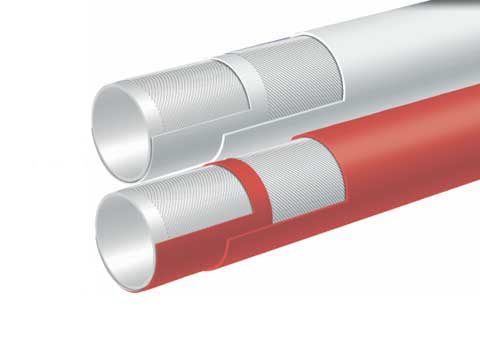
Three-layer fabric reinforcement with precision alignment ensures stable 10-bar pressure resistance, free from weak points.
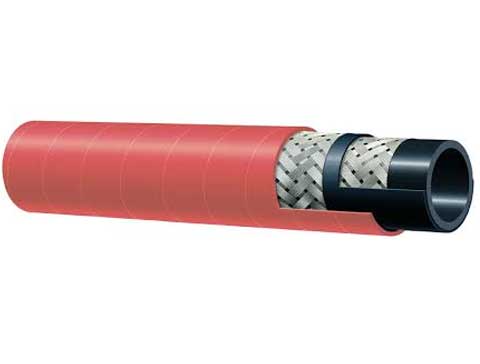
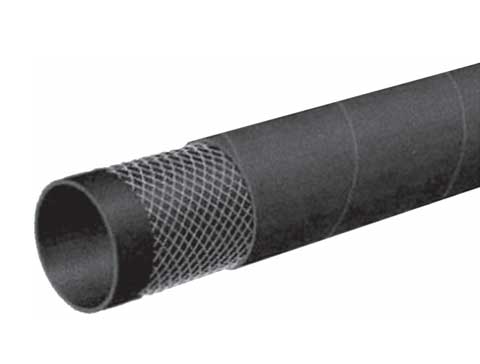
In many conventional fabric-reinforced rubber hoses, the reinforcement-wrapping process is often imprecise—characterized by an insufficient number of layers or poorly calculated winding angles—which frequently leads to localized stress concentrations. In practice, such hoses often fail to meet their nominal pressure ratings, making them prone to localized bulging or bursting. Additionally, inadequate interlayer adhesion can lead to delamination or separation during long-term pressurized operation. This EPDM hose, featuring three layers of fabric reinforcement and a 10-bar pressure rating, utilizes a high-precision CNC wrapping process. By meticulously optimizing the winding angles and tension for all three layers, the design ensures uniform stress distribution across the entire hose wall at a rated working pressure of 10 bar, effectively eliminating any weak points under pressure. The three-layer fabric reinforcement consists entirely of high-strength, rubber-impregnated polyester canvas. The winding angle for each layer is precisely calculated through mechanical simulation and arranged in a staggered, balanced configuration. This ensures that the load-bearing forces across the three layers work in synergy, evenly distributing internal stress under the 10-bar rated operating pressure and preventing any single layer from becoming overloaded. The winding tension for each layer is meticulously calibrated throughout the process using CNC equipment, keeping tension deviations to an absolute minimum. This results in a uniform wall thickness across the entire hose, eliminating weak points caused by uneven fabric stacking or inconsistent tension. The finished hose boasts a stable burst pressure exceeding 40 bar—four times its 10-bar rated operating pressure—providing a substantial safety margin that effectively withstands transient pressure fluctuations and water hammer effects, thereby preventing sudden hose ruptures.
Modified EPDM rubber is utilized as an intermediate bonding layer on both sides of the fabric reinforcement. This material shares the same molecular system as the pre-treatment adhesive coating applied to the fabric surfaces. Through a continuous high-temperature vulcanization process, the fabric fibers and the rubber achieve a molecular-level bond, effectively preventing the delamination or poor adhesion issues commonly found in standard fabric-reinforced hoses. Even during long-term continuous operation at the 10-bar rated pressure, the hose remains free from interlayer separation or blistering, ensuring the structural integrity of the entire composite assembly. For specialized applications requiring negative-pressure suction, a custom-engineered spiral steel wire reinforcement can be embedded within the three-layer fabric structure. This prevents the hose from collapsing or deforming under high negative pressure (up to -0.09 MPa), further broadening the range of environments in which the hose can be deployed. The inner lining, which comes into direct contact with the medium, is made of thickened, dense EPDM rubber, formed via a seamless, integrated extrusion process. This ensures the lining is entirely free of localized defects such as pinholes or air bubbles, effectively preventing the medium from penetrating into the fabric-reinforced layers through any weak points. The exceptionally smooth surface of the lining prevents sediment and impurities in the fluid from adhering or forming scale. Consequently, the flow cross-section remains consistent over long-term use, ensuring stable flow resistance and preventing any decline in transport efficiency due to scaling. The outermost layer utilizes a weather-resistant, modified EPDM compound, which resists rapid aging and cracking—even when exposed to long-term outdoor elements like UV radiation, ozone, and salt spray—thereby providing a robust protective barrier for the three internal fabric-reinforced layers.
Versatile for a wide range of applications, this hose offers a cost-effective, high-value solution for low-to-medium pressure fluid transport throughout its entire service life. In various general-purpose, low-to-medium pressure fluid transport scenarios, users require a fabric-reinforced hose that balances reliable pressure resistance, corrosion and weather resistance, and long service life—all at an excellent price-performance ratio. With its precisely engineered performance and extended operational lifespan, this three-layer, 10-bar-rated EPDM rubber hose delivers comprehensive cost savings and efficiency gains across its entire lifecycle.
In industrial cooling water circulation systems, conventional fabric-reinforced rubber hoses often fail within 1–2 years due to chemical corrosion or aging-related cracking. Such failures not only incur significant costs for replacement parts but can also lead to the shutdown of cooling systems—causing production losses that far exceed the value of the hose itself. By switching to this three-layer, 10-bar EPDM hose, the overall service life of the piping system can be extended to over 8 years, drastically reducing the frequency of replacements and eliminating production losses caused by unplanned downtime. In municipal outdoor applications—such as temporary water supply or construction-site drainage—these hoses can be laid in the open for extended periods without the need for additional shading or protective structures. They remain operational for years, significantly reducing both the initial setup costs for temporary piping and the burden of ongoing maintenance.
For fluid transport circuits in general machinery and equipment, the 10-bar rated working pressure is ideally suited for the circulation of water or compressed air. The inherent flexibility of the hoses effectively absorbs installation stress and minor vibrations generated during equipment operation, preventing the cracking—often seen in rigid piping—that can occur at welded joints over time. These hoses can be customized to meet specific operational requirements, offering a variety of diameters (ranging from DN25 to DN300), connection types, and functional properties. Smaller diameters can be fitted with quick-connect couplings for versatile, temporary use, while larger diameters can be equipped with flanges to facilitate the long-distance transport of high-volume fluids. Furthermore, oil-resistant variants are available for the short-distance transport of certain non-polar oil-based media, further broadening the scope of the hose's application.
During routine operation and maintenance, the condition of the hose can be easily assessed by simply inspecting the outer wall for visible signs of localized bulging, cracking, or delamination between layers. This eliminates the need for complex diagnostic procedures, greatly simplifying the maintenance of low-to-medium-pressure fluid transport systems. By choosing this three-ply, fabric-reinforced EPDM rubber hose—rated for 10-bar pressure—users in various general industrial sectors can significantly lower their annual procurement costs and minimize the risk of unexpected downtime caused by pipeline failure. It serves as a highly reliable, cost-effective, and durable solution for fluid transport in a wide range of low-to-medium-pressure applications.