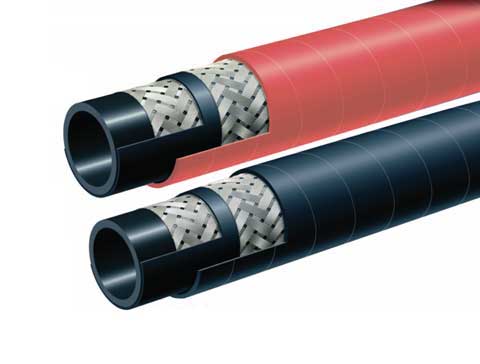
Drilling and production hose; large-diameter mud transfer hose; 6-inch inner diameter; burst pressure 2.5 times the working pressure.
release date:2026-10-08 10:11:15
reading volume:
share:
 In deep-sea drilling and onshore operations using ultra-deep well rigs, the mud circulation system serves as the "lifeline" for maintaining wellbore stability, transporting cuttings, and cooling the drill bit. As well depths increase and bottom-hole assemblies become more complex, annular pressure loss rises sharply; consequently, increasing the pipe diameter is essential to maintain the flow rate required to transport cuttings to the surface. The large-bore mud delivery hose—featuring a 6-inch inner diameter—is a flexible conduit specifically designed to meet these high-flow-rate demands. Furthermore, a safety margin where the burst pressure is 2.5 times the working pressure provides robust structural protection against the transient overpressure events frequently encountered at drilling sites.
I. 6-Inch Large Bore: An Engineering Choice for High-Flow Mud Circulation
The diameter of the mud delivery hose directly determines the maximum flow rate of the circulation system. In deep and ultra-deep well operations, the mud return velocity must reach a critical threshold to effectively transport cuttings; industry experience indicates that the annular return velocity generally needs to be maintained above 0.6–1.2 m/s. If a 4-inch hose is used, it is difficult to meet the flow rate requirements for large-diameter and deep-well sections without increasing pump pressure; insufficient flow leads to cuttings accumulation in the annulus, triggering downhole incidents such as stuck pipe and wellbore instability.
A hose with a 6-inch inner diameter offers 2.25 times the flow area of a 4-inch hose, allowing for a higher flow rate at the same velocity, or a lower velocity at the same flow rate. The engineering significance of this design lies in the ability to increase flow rates—despite limitations on pump power and pressure ratings—while simultaneously reducing wear on the hose wall caused by high-velocity mud erosion.
In accordance with API 7K standards, the 6-inch large-bore mud delivery hose is rated for a working pressure of 5,000 psi (approximately 34.5 MPa), with a burst pressure of no less than 2.5 times the working pressure (12,500 psi). For large-bore specifications ranging from 1-1/4 inches to 2 inches, the working pressure decreases as the bore size increases, yet the 2.5x burst safety factor remains constant. This unified safety benchmark ensures a consistent safety margin when selecting hoses across different bore sizes.
II. Structural Basis for the 2.5x Burst Safety Margin: Mechanical Design of Multi-Layer Steel Wire Spiraling
A burst pressure of 2.5 times the working pressure is a mandatory requirement under the API 7K standard for hoses rated Class D and above. The key to achieving this safety margin lies in the precision structural design of the reinforcement layers.
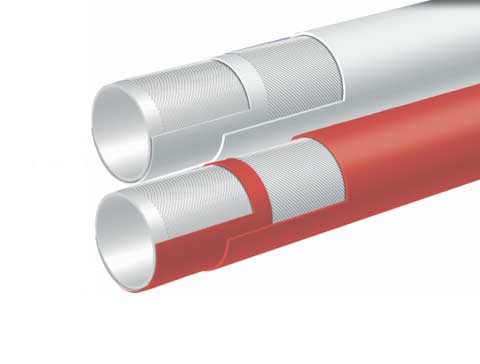
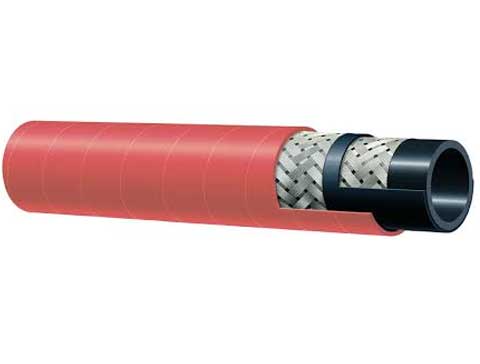
The 6-inch large-bore mud transfer hose utilizes a structure consisting of 4 to 6 layers of high-strength steel wire spirally wound around the core. Each layer is wound at a precisely calculated spiral angle: inner layers utilize a steeper angle to provide radial support, resisting the hose's tendency to bulge or deform under high pressure; outer layers utilize a shallower angle to form an axial tensile framework, bearing the tensile loads generated by mud pump pulsations and top-drive movement. High-adhesion intermediate rubber layers bond the wire layers into a solid, integrated unit, allowing them to deform in unison under pulsating loads and preventing interlayer delamination caused by stress concentration.
Precise control over steel wire tensile strength and winding tension is critical to achieving the 2.5x burst pressure rating. Taking the 6-inch specification as an example, the hoop stress exerted on the hose body is directly proportional to the bore diameter; consequently, the number of reinforcement wire layers and the strength of individual wires must be increased accordingly. The uniform winding of high-toughness galvanized steel wire ensures an even distribution of forces across all layers, preventing localized stress concentrations that could otherwise become weak points leading to burst failure.
The inner rubber layer comes into direct contact with the mud medium, enduring continuous erosion from rock cuttings and chemical attack from additives. Liner options include HNBR (Hydrogenated Nitrile Butadiene Rubber) or UPE (Ultra-High Molecular Weight Polyethylene); UPE, in particular, offers wear resistance six to seven times greater than standard rubber, making it exceptionally well-suited for deep-well mud handling operations involving high sand content. The outer rubber layer utilizes wear-resistant, weather-resistant synthetic rubber to protect the reinforcement layer from erosion caused by exposure to sun, rain, oil splashes, and other environmental factors found on offshore platforms or open-air sites.
III. Riser Application Suitability: From Pressure Pulses to Connection Safety
The 6-inch large-bore mud transfer hose serves two primary functions in drilling systems: acting as a flexible connection between the top of the riser and the top drive/rotary unit to compensate for axial displacement caused by top drive movement; and serving as a flexible link between the mud pump and the base of the riser to absorb pump vibrations and dampen pressure pulsations.
Handling pressure pulsations is a critical challenge for large-bore mud hoses. Mud pumps are typically reciprocating plunger pumps that generate a pressure pulse with every stroke, at frequencies ranging from tens to over a hundred cycles per minute. As the hose diameter increases, the surface area upon which pulse loads act on the reinforcement layer also increases, imposing stricter requirements on interlayer bond strength. The multi-layer steel wire winding structure—utilizing high-adhesion interlayer compounds and precise winding angle control—evenly distributes pulse loads across the layers, ensuring the hose maintains structural integrity during prolonged cyclic loading.
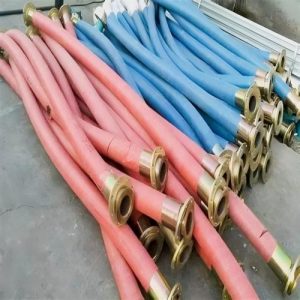
Regarding end connections, 6-inch large-bore hoses are typically fitted with integral union or flange connectors. The union connectors feature a misalignment-tolerant design that accommodates angular deviations, making them suitable for top-drive operations where precise pipeline alignment is difficult to achieve. The connectors are attached to the hose body via a precision swaging process, with compression levels strictly controlled within manufacturing tolerances to prevent pull-out or leakage under high-pressure pulsations.
Installation specifications are particularly critical for large-bore hoses. For the 6-inch size, the minimum bend radius is typically required to exceed 1600 mm; installers must ensure the bend radius does not fall below this rated value to prevent damage to the reinforcement layer caused by sharp bends. In areas subject to high vibration, such as mud pump outlets, specialized clamps and vibration-damping devices should be used to secure the hose and minimize fatigue damage. Routine inspections should focus on checking the outer rubber layer for bulges or abrasion that exposes the steel wire, as well as looking for signs of leakage at the connections; any anomalies detected require immediate replacement.
In summary, this drilling and production hose—featuring a 6-inch inner diameter and a burst pressure 2.5 times its working pressure—perfectly meets the systematic requirements for "high flow rate, high safety, and continuous reliability" in deep-sea and ultra-deep well operations. It achieves this through three core technical strengths: high-volume mud transport enabled by the large-bore design, a 2.5-fold burst safety margin provided by 4–6 layers of steel wire reinforcement, and dynamic compensation combined with secure connectivity for standpipe applications. From the flow area afforded by the 6-inch bore and the 12,500 psi burst rating to the choice of media-resistant HNBR/UPE liners and the rapid-connection Fig 1003 unions, every specification and design element serves a singular goal: to provide a reliable conduit for high-pressure mud transport—capable of withstanding pressure surges and continuous circulation—amidst the roar of drilling rigs on thousand-meter derricks.
In deep-sea drilling and onshore operations using ultra-deep well rigs, the mud circulation system serves as the "lifeline" for maintaining wellbore stability, transporting cuttings, and cooling the drill bit. As well depths increase and bottom-hole assemblies become more complex, annular pressure loss rises sharply; consequently, increasing the pipe diameter is essential to maintain the flow rate required to transport cuttings to the surface. The large-bore mud delivery hose—featuring a 6-inch inner diameter—is a flexible conduit specifically designed to meet these high-flow-rate demands. Furthermore, a safety margin where the burst pressure is 2.5 times the working pressure provides robust structural protection against the transient overpressure events frequently encountered at drilling sites.
I. 6-Inch Large Bore: An Engineering Choice for High-Flow Mud Circulation
The diameter of the mud delivery hose directly determines the maximum flow rate of the circulation system. In deep and ultra-deep well operations, the mud return velocity must reach a critical threshold to effectively transport cuttings; industry experience indicates that the annular return velocity generally needs to be maintained above 0.6–1.2 m/s. If a 4-inch hose is used, it is difficult to meet the flow rate requirements for large-diameter and deep-well sections without increasing pump pressure; insufficient flow leads to cuttings accumulation in the annulus, triggering downhole incidents such as stuck pipe and wellbore instability.
A hose with a 6-inch inner diameter offers 2.25 times the flow area of a 4-inch hose, allowing for a higher flow rate at the same velocity, or a lower velocity at the same flow rate. The engineering significance of this design lies in the ability to increase flow rates—despite limitations on pump power and pressure ratings—while simultaneously reducing wear on the hose wall caused by high-velocity mud erosion.
In accordance with API 7K standards, the 6-inch large-bore mud delivery hose is rated for a working pressure of 5,000 psi (approximately 34.5 MPa), with a burst pressure of no less than 2.5 times the working pressure (12,500 psi). For large-bore specifications ranging from 1-1/4 inches to 2 inches, the working pressure decreases as the bore size increases, yet the 2.5x burst safety factor remains constant. This unified safety benchmark ensures a consistent safety margin when selecting hoses across different bore sizes.
II. Structural Basis for the 2.5x Burst Safety Margin: Mechanical Design of Multi-Layer Steel Wire Spiraling
A burst pressure of 2.5 times the working pressure is a mandatory requirement under the API 7K standard for hoses rated Class D and above. The key to achieving this safety margin lies in the precision structural design of the reinforcement layers.
The 6-inch large-bore mud transfer hose utilizes a structure consisting of 4 to 6 layers of high-strength steel wire spirally wound around the core. Each layer is wound at a precisely calculated spiral angle: inner layers utilize a steeper angle to provide radial support, resisting the hose's tendency to bulge or deform under high pressure; outer layers utilize a shallower angle to form an axial tensile framework, bearing the tensile loads generated by mud pump pulsations and top-drive movement. High-adhesion intermediate rubber layers bond the wire layers into a solid, integrated unit, allowing them to deform in unison under pulsating loads and preventing interlayer delamination caused by stress concentration.
Precise control over steel wire tensile strength and winding tension is critical to achieving the 2.5x burst pressure rating. Taking the 6-inch specification as an example, the hoop stress exerted on the hose body is directly proportional to the bore diameter; consequently, the number of reinforcement wire layers and the strength of individual wires must be increased accordingly. The uniform winding of high-toughness galvanized steel wire ensures an even distribution of forces across all layers, preventing localized stress concentrations that could otherwise become weak points leading to burst failure.
The inner rubber layer comes into direct contact with the mud medium, enduring continuous erosion from rock cuttings and chemical attack from additives. Liner options include HNBR (Hydrogenated Nitrile Butadiene Rubber) or UPE (Ultra-High Molecular Weight Polyethylene); UPE, in particular, offers wear resistance six to seven times greater than standard rubber, making it exceptionally well-suited for deep-well mud handling operations involving high sand content. The outer rubber layer utilizes wear-resistant, weather-resistant synthetic rubber to protect the reinforcement layer from erosion caused by exposure to sun, rain, oil splashes, and other environmental factors found on offshore platforms or open-air sites.
III. Riser Application Suitability: From Pressure Pulses to Connection Safety
The 6-inch large-bore mud transfer hose serves two primary functions in drilling systems: acting as a flexible connection between the top of the riser and the top drive/rotary unit to compensate for axial displacement caused by top drive movement; and serving as a flexible link between the mud pump and the base of the riser to absorb pump vibrations and dampen pressure pulsations.
Handling pressure pulsations is a critical challenge for large-bore mud hoses. Mud pumps are typically reciprocating plunger pumps that generate a pressure pulse with every stroke, at frequencies ranging from tens to over a hundred cycles per minute. As the hose diameter increases, the surface area upon which pulse loads act on the reinforcement layer also increases, imposing stricter requirements on interlayer bond strength. The multi-layer steel wire winding structure—utilizing high-adhesion interlayer compounds and precise winding angle control—evenly distributes pulse loads across the layers, ensuring the hose maintains structural integrity during prolonged cyclic loading.
Regarding end connections, 6-inch large-bore hoses are typically fitted with integral union or flange connectors. The union connectors feature a misalignment-tolerant design that accommodates angular deviations, making them suitable for top-drive operations where precise pipeline alignment is difficult to achieve. The connectors are attached to the hose body via a precision swaging process, with compression levels strictly controlled within manufacturing tolerances to prevent pull-out or leakage under high-pressure pulsations.
Installation specifications are particularly critical for large-bore hoses. For the 6-inch size, the minimum bend radius is typically required to exceed 1600 mm; installers must ensure the bend radius does not fall below this rated value to prevent damage to the reinforcement layer caused by sharp bends. In areas subject to high vibration, such as mud pump outlets, specialized clamps and vibration-damping devices should be used to secure the hose and minimize fatigue damage. Routine inspections should focus on checking the outer rubber layer for bulges or abrasion that exposes the steel wire, as well as looking for signs of leakage at the connections; any anomalies detected require immediate replacement.
In summary, this drilling and production hose—featuring a 6-inch inner diameter and a burst pressure 2.5 times its working pressure—perfectly meets the systematic requirements for "high flow rate, high safety, and continuous reliability" in deep-sea and ultra-deep well operations. It achieves this through three core technical strengths: high-volume mud transport enabled by the large-bore design, a 2.5-fold burst safety margin provided by 4–6 layers of steel wire reinforcement, and dynamic compensation combined with secure connectivity for standpipe applications. From the flow area afforded by the 6-inch bore and the 12,500 psi burst rating to the choice of media-resistant HNBR/UPE liners and the rapid-connection Fig 1003 unions, every specification and design element serves a singular goal: to provide a reliable conduit for high-pressure mud transport—capable of withstanding pressure surges and continuous circulation—amidst the roar of drilling rigs on thousand-meter derricks.
Previous: