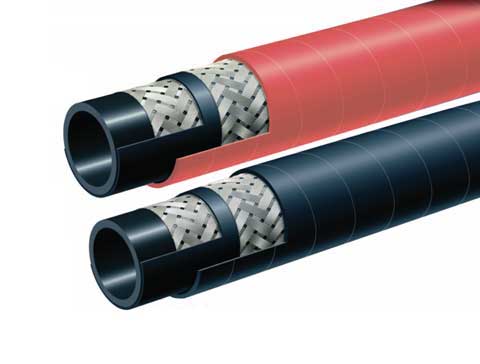
Ultra high pressure cleaning hose with nylon inner layer and four layers of steel wire winding, working pressure 320MPa
release date:2026-08-31 10:03:58
reading volume:
share:
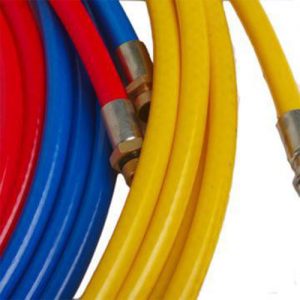 In the fields of industrial cleaning, hydraulic fracturing, and water jet cutting, a working pressure of 320MPa (approximately 46400psi) means that the water jet speed can reach over 1000m/s - enough to strip ship rust, break reinforced concrete, and cut high-strength composite materials. The cleaning hose that carries this ultimate pressure is the "lifeline" of the entire ultra-high pressure system. It not only needs to maintain structural integrity in continuous high pressure and high-frequency pulses, but also needs to have on-site operational characteristics such as wear resistance, chemical resistance, flexibility, and lightness. The ultra-high pressure cleaning hose with nylon inner layer and four layers of steel wire winding as the core is an engineering solution for this extreme working condition - the high strength and low friction characteristics of nylon resin ensure smooth transmission of the medium, the multi-layer steel wire winding structure carries 320MPa working pressure and 800MPa blasting redundancy, and the polyurethane outer sheath resists on-site mechanical wear and environmental erosion, becoming a reliable channel for "high-pressure non bursting, pulse non fatigue" in ultra-high pressure water jet operations such as ship cleaning and hydraulic demolition.
1、 The "high strength and low resistance" characteristics of nylon inner layer: medium channel at 320MPa
At an ultra-high pressure of 320MPa (approximately 46400psi), the water flow velocity can reach over 1000m/s. The inner layer material not only needs to withstand huge circumferential stress, but also needs to have extremely low flow resistance to maintain jet energy. The selection of nylon (PA) inner layer is based on this dual logic: the tensile strength of nylon resin can reach 70-100MPa, and it is not easy to undergo creep deformation under internal pressure; Its extremely low inner wall friction coefficient (about 0.1-0.3) results in minimal resistance along the way when high-pressure water flows through, effectively reducing pressure drop and energy loss.
Compared with traditional rubber lining, nylon lining exhibits significant advantages under ultra-high pressure conditions. Rubber lining is prone to "breathing effect" and fatigue cracking under repeated high-pressure impacts, while nylon resin has a higher elastic modulus (about 2-3GPa), lower volume expansion rate, and better dimensional stability of the pipe body under pressure fluctuations. This is crucial for frequent "pump start hold release" cycles in ultra-high pressure cleaning operations. The product parameters show that the inner diameter of the 320MPa cleaning hose covers 3-10mm and can be selected according to the operating flow requirements. The inner diameter of 7.8mm corresponds to a working pressure of 320MPa and a burst pressure of up to 800MPa.
In terms of temperature adaptation range, the nylon inner layer maintains stable physical properties in a wide temperature range of -40 ℃ to+100 ℃, which can adapt to different scenarios from outdoor cleaning in winter in the north to high-temperature operations in ship cabins in summer.
2、 The bearing logic of four layer steel wire winding: mechanical skeleton under 320MPa pressure
The burst pressure corresponding to a working pressure of 320MPa usually reaches 800MPa (approximately 116000psi), which is 2.5 times the working pressure. The implementation of this security redundancy relies on the precise design of the reinforcement layer - a four layer high-strength steel wire spiral winding structure.
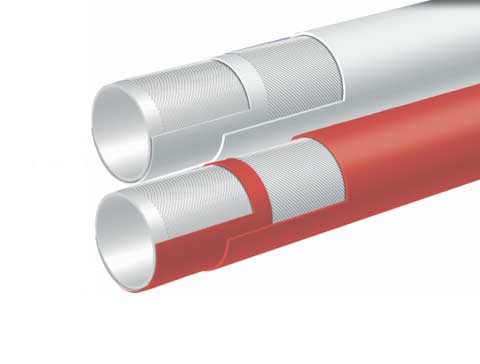
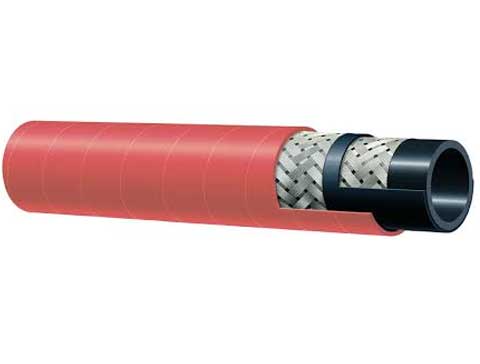
Unlike weaving structures, the winding process arranges each layer of steel wire at a precise spiral angle of 54 ° -55 °, with adjacent layers wound in alternating directions to form an "interlocking" mechanical skeleton. The four layer winding structure achieves a burst pressure of 320MPa level through the mechanical mechanism of "layered bearing and stress equalization": the inner steel wire provides radial support at a higher angle to resist the bulging of the pipe body under high pressure; The outer steel wire constructs an axial tensile skeleton at a lower angle to prevent excessive elongation of the hose under pulse pressure. The layers form a strong whole through a highly adhesive medium, which collaboratively deforms during pressure fluctuations rather than sliding relative to each other. Product data shows that the minimum bending radius of the four layer winding structure can reach 230-280mm (DN8 specification), while maintaining the ultra-high pressure bearing capacity and considering the flexibility of on-site pipe laying.
For scenarios that pursue higher pressure, a six or eight layer steel wire winding structure can increase the working pressure to the 400MPa level, with a burst pressure of 1000MPa and a safety factor of 2.5:1.
3、 Adaptation and safety standards for cleaning scenarios: from ship rust removal to hydraulic dismantling
The practical value of ultra-high pressure cleaning hoses is reflected in the high efficiency and safety of professional operations such as ship cleaning, hydraulic fracturing, and concrete chiseling. In the field of ship cleaning, hoses transport ultra-high pressure purified water through specially designed rotating nozzles, which can efficiently remove rust, old coatings, and marine biological attachments on the surface of the ship. The cleaning process is free of chemical pollution and substrate damage, making it an ideal solution to replace traditional sandblasting processes. In the field of hydraulic demolition, by utilizing the cold cutting characteristics of ultra-high pressure water jet and adjusting the water jet pressure and spray angle, concrete structures can be accurately broken, with an efficiency more than 20 times that of traditional pneumatic picks, and without sparks, high temperatures, or dust. It has irreplaceable safety advantages in flammable and explosive places.
In terms of safety regulations and installation points, the use of 320MPa grade ultra-high pressure cleaning hoses must strictly comply with multiple safety requirements. The bending radius during installation should not be less than the rated value (about 230-280mm) to avoid damage to the steel wire layer caused by excessive bending; The end joint must use a matching anti pull joint, which ensures that the joint does not loosen or leak under ultra-high voltage pulses through precision crimping technology. Before daily use, the outer sheath should be checked for cuts or wear, and a hydrostatic pressure test should be conducted every 2 years or according to the strength of use to confirm the pressure integrity of the hose. Operators must wear protective goggles and face shields to prevent high-pressure water jets from splashing back and injuring people.
In summary, the ultra-high pressure cleaning hose with nylon inner layer, four layer steel wire winding, and a working pressure of 320MPa perfectly meets the systematic requirements of industrial ultra-high pressure cleaning for "extreme pressure, safety and reliability, and significant efficiency" due to its low flow resistance and dimensional stability of nylon resin inner layer, 800MPa blasting redundancy of multi-layer winding structure, and wide temperature range of -40 ℃ to 100 ℃ and adaptability to ship/demolition scenes. From the redundancy of 800MPa blasting to the ample margin of 2.5 times the safety factor, from the chemical pollution free cleaning of ship rust removal to the 20 times efficiency leap of hydraulic demolition, the design of each layer of steel wire winding and every millimeter of nylon inner wall points to the same goal: to provide a flexible channel for industrial cleaning and demolition operations that does not burst, leak, and is efficient and reliable under the ultimate pressure of ultra-high pressure water jet.
In the fields of industrial cleaning, hydraulic fracturing, and water jet cutting, a working pressure of 320MPa (approximately 46400psi) means that the water jet speed can reach over 1000m/s - enough to strip ship rust, break reinforced concrete, and cut high-strength composite materials. The cleaning hose that carries this ultimate pressure is the "lifeline" of the entire ultra-high pressure system. It not only needs to maintain structural integrity in continuous high pressure and high-frequency pulses, but also needs to have on-site operational characteristics such as wear resistance, chemical resistance, flexibility, and lightness. The ultra-high pressure cleaning hose with nylon inner layer and four layers of steel wire winding as the core is an engineering solution for this extreme working condition - the high strength and low friction characteristics of nylon resin ensure smooth transmission of the medium, the multi-layer steel wire winding structure carries 320MPa working pressure and 800MPa blasting redundancy, and the polyurethane outer sheath resists on-site mechanical wear and environmental erosion, becoming a reliable channel for "high-pressure non bursting, pulse non fatigue" in ultra-high pressure water jet operations such as ship cleaning and hydraulic demolition.
1、 The "high strength and low resistance" characteristics of nylon inner layer: medium channel at 320MPa
At an ultra-high pressure of 320MPa (approximately 46400psi), the water flow velocity can reach over 1000m/s. The inner layer material not only needs to withstand huge circumferential stress, but also needs to have extremely low flow resistance to maintain jet energy. The selection of nylon (PA) inner layer is based on this dual logic: the tensile strength of nylon resin can reach 70-100MPa, and it is not easy to undergo creep deformation under internal pressure; Its extremely low inner wall friction coefficient (about 0.1-0.3) results in minimal resistance along the way when high-pressure water flows through, effectively reducing pressure drop and energy loss.
Compared with traditional rubber lining, nylon lining exhibits significant advantages under ultra-high pressure conditions. Rubber lining is prone to "breathing effect" and fatigue cracking under repeated high-pressure impacts, while nylon resin has a higher elastic modulus (about 2-3GPa), lower volume expansion rate, and better dimensional stability of the pipe body under pressure fluctuations. This is crucial for frequent "pump start hold release" cycles in ultra-high pressure cleaning operations. The product parameters show that the inner diameter of the 320MPa cleaning hose covers 3-10mm and can be selected according to the operating flow requirements. The inner diameter of 7.8mm corresponds to a working pressure of 320MPa and a burst pressure of up to 800MPa.
In terms of temperature adaptation range, the nylon inner layer maintains stable physical properties in a wide temperature range of -40 ℃ to+100 ℃, which can adapt to different scenarios from outdoor cleaning in winter in the north to high-temperature operations in ship cabins in summer.
2、 The bearing logic of four layer steel wire winding: mechanical skeleton under 320MPa pressure
The burst pressure corresponding to a working pressure of 320MPa usually reaches 800MPa (approximately 116000psi), which is 2.5 times the working pressure. The implementation of this security redundancy relies on the precise design of the reinforcement layer - a four layer high-strength steel wire spiral winding structure.
Unlike weaving structures, the winding process arranges each layer of steel wire at a precise spiral angle of 54 ° -55 °, with adjacent layers wound in alternating directions to form an "interlocking" mechanical skeleton. The four layer winding structure achieves a burst pressure of 320MPa level through the mechanical mechanism of "layered bearing and stress equalization": the inner steel wire provides radial support at a higher angle to resist the bulging of the pipe body under high pressure; The outer steel wire constructs an axial tensile skeleton at a lower angle to prevent excessive elongation of the hose under pulse pressure. The layers form a strong whole through a highly adhesive medium, which collaboratively deforms during pressure fluctuations rather than sliding relative to each other. Product data shows that the minimum bending radius of the four layer winding structure can reach 230-280mm (DN8 specification), while maintaining the ultra-high pressure bearing capacity and considering the flexibility of on-site pipe laying.
For scenarios that pursue higher pressure, a six or eight layer steel wire winding structure can increase the working pressure to the 400MPa level, with a burst pressure of 1000MPa and a safety factor of 2.5:1.
3、 Adaptation and safety standards for cleaning scenarios: from ship rust removal to hydraulic dismantling
The practical value of ultra-high pressure cleaning hoses is reflected in the high efficiency and safety of professional operations such as ship cleaning, hydraulic fracturing, and concrete chiseling. In the field of ship cleaning, hoses transport ultra-high pressure purified water through specially designed rotating nozzles, which can efficiently remove rust, old coatings, and marine biological attachments on the surface of the ship. The cleaning process is free of chemical pollution and substrate damage, making it an ideal solution to replace traditional sandblasting processes. In the field of hydraulic demolition, by utilizing the cold cutting characteristics of ultra-high pressure water jet and adjusting the water jet pressure and spray angle, concrete structures can be accurately broken, with an efficiency more than 20 times that of traditional pneumatic picks, and without sparks, high temperatures, or dust. It has irreplaceable safety advantages in flammable and explosive places.
In terms of safety regulations and installation points, the use of 320MPa grade ultra-high pressure cleaning hoses must strictly comply with multiple safety requirements. The bending radius during installation should not be less than the rated value (about 230-280mm) to avoid damage to the steel wire layer caused by excessive bending; The end joint must use a matching anti pull joint, which ensures that the joint does not loosen or leak under ultra-high voltage pulses through precision crimping technology. Before daily use, the outer sheath should be checked for cuts or wear, and a hydrostatic pressure test should be conducted every 2 years or according to the strength of use to confirm the pressure integrity of the hose. Operators must wear protective goggles and face shields to prevent high-pressure water jets from splashing back and injuring people.
In summary, the ultra-high pressure cleaning hose with nylon inner layer, four layer steel wire winding, and a working pressure of 320MPa perfectly meets the systematic requirements of industrial ultra-high pressure cleaning for "extreme pressure, safety and reliability, and significant efficiency" due to its low flow resistance and dimensional stability of nylon resin inner layer, 800MPa blasting redundancy of multi-layer winding structure, and wide temperature range of -40 ℃ to 100 ℃ and adaptability to ship/demolition scenes. From the redundancy of 800MPa blasting to the ample margin of 2.5 times the safety factor, from the chemical pollution free cleaning of ship rust removal to the 20 times efficiency leap of hydraulic demolition, the design of each layer of steel wire winding and every millimeter of nylon inner wall points to the same goal: to provide a flexible channel for industrial cleaning and demolition operations that does not burst, leak, and is efficient and reliable under the ultimate pressure of ultra-high pressure water jet.
Previous: